
Skip to content
JoruJoru
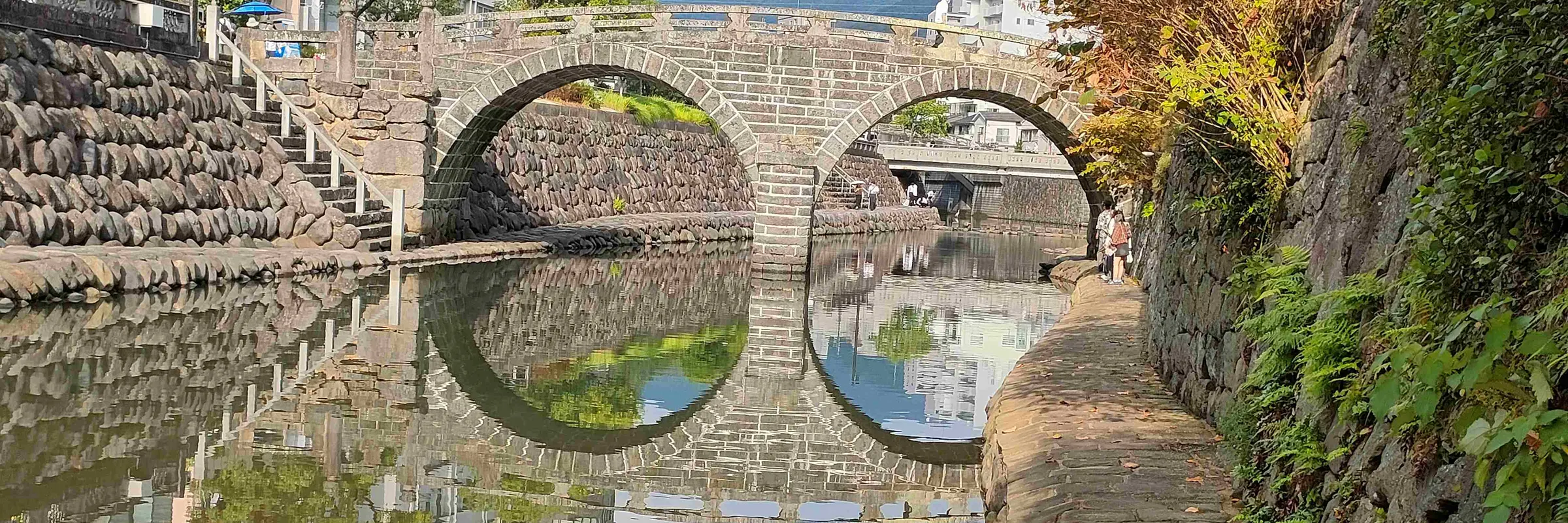
Nagasaki: The spectacles bridge over the Nakashima River, with its reflection

Kyūshū, Japan

Nagasaki: how many days you need and the best months to go

Photo: Yoshi Canopus · CC0

Nagasaki has more history per hillside than any city in Japan. Portuguese traders and Jesuits arrived here in the sixteenth century; during the two centuries when Japan closed itself to the world, the Dutch trading post on a small artificial island in its harbour was the country's only opening to Europe, and the Chinese merchants beside it left a Chinatown and their temples. Christianity, banned and hidden for two hundred and fifty years, came out of hiding here. And on the ninth of August 1945 the city became the second, and so far last, to be destroyed by an atomic bomb. It is built on steep slopes around a long harbour, it is easier to explore than it looks thanks to its trams, and it rewards two or three days.

Short answers

What people ask before booking

How many days do you need in Nagasaki?

Nagasaki needs two days: one for the Peace Park and the Atomic Bomb Museum, one for Dejima, Chinatown, the old church and the merchants' hillside garden, ending with the night view from Mount Inasa. A third day is for the boat to Battleship Island, whose landings depend on the sea.

What is the best month to visit Nagasaki?

October and November — Clear autumn days and the great festival. March to May — Spring on the slopes.

Work out how many hours you will have in Nagasaki on your dates
When to go, and what each month costs you

Nagasaki is mild in winter and hot and wet in summer, with one of the rainiest rainy seasons in Japan in June and July. Spring and autumn are the windows, the autumn festival in early October fills the city, and the sea, which decides the boats to Battleship Island, is calmest outside the typhoon season.

  1. January: Worth it, but
  2. February: Worth it, but
  3. March: Go now
  4. April: Go now
  5. May: Go now
  6. June: Worth it, but
  7. July: Worth it, but
  8. August: Worth it, but
  9. September: Worth it, but
  10. October: Go now
  11. November: Go now
  12. December: Worth it, but
  • October and November

    Go now

    Clear autumn days and the great festival

    Mild, dry and clear, with calmer seas for the boats to Hashima. The Kunchi, the festival of the city's main shrine, fills the streets with Chinese dragon dances and decorated floats on the seventh, eighth and ninth of October — fixed dates every year, and hotels sell out. November is quieter and just as pleasant.

  • March to May

    Go now

    Spring on the slopes

    Mild days, cherry blossom around the end of March or the start of April, and the slopes at their greenest by May; the dates of the blossom move every year. The May holidays bring crowds from all over Japan. Rain becomes more frequent towards the end of May.

  • June and July

    Worth it, but

    Heavy rains, then summer

    The rainy season is long and heavy here, with downpours that can disrupt transport from June into mid-July. Then the heat arrives. Prices are lower and the sights quieter.

  • August and September

    Worth it, but

    Heat, the anniversary and typhoons

    Hot and humid, with typhoons possible from August into September that stop the boats and sometimes the trains. On the ninth of August the city commemorates the bomb with a ceremony at the Peace Park, a solemn day with a minute of silence across the city. The Obon holiday, with its boat processions for the dead, follows in mid-August.

  • December to February

    Worth it, but

    Mild winter, and the lantern festival

    Cool and often grey, but rarely cold, and the quietest season. The lantern festival around the Chinese New Year, in late January or February, hangs thousands of lanterns across the centre for two weeks; its dates move with the lunar calendar every year. Hotels fill then.

What to pack for Nagasaki, month by month

How many days Nagasaki needs

Two days cover the city. One for the north, where the bomb fell: the Peace Park, the museum and the hypocentre, and the cathedral that was rebuilt nearby. One for the south and the harbour: the Dutch trading island of Dejima, Chinatown, the hillside garden of the Western merchants and the oldest church in Japan, ending on the mountain across the harbour for the view at night.

The third day is for the sea. Boats leave the harbour for the abandoned coal-mining island of Hashima, the one people call Battleship Island, and a landing there depends entirely on the weather. Keep a spare half-day in case the first boat cannot land, or use it for the hot springs of Unzen or the theme park of Dutch-style buildings near Sasebo.

How the city is arranged, around a harbour

Nagasaki fills a long, narrow valley and the slopes around a deep harbour. Houses climb the hills in terraces, linked by stairways and lanes too steep for cars, and the flat land at the bottom carries the tram lines and the main streets. The city runs north to south along the valley.

  • Urakami, in the north — the district destroyed by the bomb: the Peace Park, the Atomic Bomb Museum, the hypocentre and the cathedral.
  • Around the station — the railway station, rebuilt for the new high-speed line, and the monument to the twenty-six martyrs on the hill beside it.
  • The old centre — Dejima, Chinatown, the stone bridges over the Nakashima River and the shopping arcades of Hamanomachi.
  • Minamiyamate — the hillside of the Western merchants in the south: the garden of their houses, the old church and, just to the north, the Dutch Slope.
  • Mount Inasa — the mountain across the harbour, reached by ropeway, with one of the most famous night views in Japan.

Where to stay, and what each area costs you

The trams link every district, so the choice is about evenings and views. The centre is the liveliest, the station the most practical, and the hillsides the most beautiful — at the price of stairs.

Hotels fill in early October for the city's great autumn festival, during the lantern festival around Chinese New Year, and around the ninth of August, the anniversary of the bomb.

AreaWho it suitsThe catch
Around Nagasaki StationArriving and leaving by train or airport bus, with the trams to everything at the door.A modern district without much character, and a tram ride to the old centre in the evening.
Hamanomachi and ShianbashiThe centre of the evening: the shopping arcades, Chinatown and the bar district on foot.Busy and noisy around the bars at night, and the hotels are mostly plain.
Minamiyamate and the harbourHarbour views, the old Western houses and the church a few steps away.Steep streets and stairways, and little open in the evening.
Mount InasaHotels high above the harbour with the night view from the window.Far from the centre, and every outing means a bus or a taxi down the hill.

Compare these areas against your priorities

Getting there, and up and down the hills

The high-speed line from Fukuoka is in two halves: a limited express from Hakata to Takeo-Onsen, and a short bullet train from there to Nagasaki, with a change on the same platform. The whole trip takes about an hour and a half. Nagasaki's airport is on an island in a bay north of the city, linked by a bus of under an hour.

The trams are the way to get around: old cars and new, on lines that link the station, the Peace Park, the centre and the south, at a low flat fare whatever the distance.

  • Walk the hillsides, ride the valleys. The trams cover the flat land; the slopes are stairways, so plan the walking downhill where you can.
  • An inclined lift and a few public elevators climb some of the steepest slopes, including one to the upper entrance of the merchants' garden.
  • The ropeway up Mount Inasa is the easy way to the night view; buses and taxis go up too.
  • A one-day tram pass pays for itself after a few rides.

The bomb, the hidden Christians and the abandoned island

The Atomic Bomb Museum and the Peace Park are the reason many people come, and they are hard and necessary. The museum tells the story of the ninth of August through objects, photographs and the testimony of survivors; the park, on the hill above the hypocentre, holds the great seated statue of peace. Give them a morning, and leave the afternoon light.

  • Dejima — the fan-shaped island where Dutch traders were confined for two centuries, its warehouses and houses rebuilt as they were, now surrounded by the city.
  • Ōura Church — the oldest church in Japan, built for foreign residents in the 1860s, where hidden Christians revealed themselves to a French priest after two and a half centuries of secret faith. Part of a World Heritage listing of the region's hidden Christian sites.
  • Glover Garden — the hillside houses and gardens of the Western merchants of the nineteenth century, with the oldest Western-style wooden house in Japan and a view over the harbour.
  • Hashima (Battleship Island) — a coal-mining island abandoned in the 1970s, its concrete apartment blocks crumbling at sea. Boats circle it and land on designated walkways when the sea allows; book ahead and expect cancellations in rough weather.
  • The spectacles bridge — a double stone arch over the Nakashima River whose reflection draws a pair of glasses, among the oldest stone bridges in Japan.
  • The night view from Mount Inasa — the city's lights wrapped around the harbour; go up before sunset to see it change.

How eating works here

Nagasaki's food is the result of the trade that passed through its port: Chinese, Portuguese and Dutch influences that became local dishes over three centuries. The city's great noodle dish was invented by a Chinese restaurateur, its sponge cake came from the Portuguese, and its banquet cuisine served Japanese, Chinese and Western dishes on the same round table.

Chinatown is the place for the noodles; the old pastry shops for the cake; and the restaurants of the centre for the rest. The harbour also gives the city some of the best fish in Kyūshū.

  • Chinatown is small and busy, four streets with gates at each end; it is at its liveliest in the evening and during the lantern festival.
  • The sponge cake is sold by old shops founded centuries ago; buy it from one of them, wrapped, as a gift that lasts several days.
  • The banquet cuisine is served at a few traditional restaurants, usually for groups and by reservation.
  • Tipping is not done.

Where to eat in Nagasaki, and what to order

Nagasaki eats what its port brought: a noodle soup invented for Chinese students, a sponge cake from the Portuguese, and a plate that combines three cuisines in one. Eat the noodles in Chinatown, the cake from a shop that has made it for centuries, and the rest wherever the locals queue.

  • Champon

    What to order

    The noodle soup the city invented

    Thick noodles in a rich, milky broth of pork and chicken, piled with stir-fried pork, seafood and vegetables. A Chinese restaurateur created it at the end of the nineteenth century as a cheap, filling meal for Chinese students, and it has been the city's dish ever since. Order it in Chinatown; one bowl is a full meal.

    Check it on Wikidata
  • Sara udon

    What to order

    The same dish, crisp

    The same topping of pork, seafood and vegetables in a thick sauce, poured over a nest of fried noodles that are crisp at the edges and soften as you eat. Locals add a dash of Worcestershire-style sauce at the table. It is served wherever champon is, and choosing between the two is a local argument.

    Check it on Wikidata
  • Castella

    What to order

    The sponge cake of the Portuguese

    A moist, dense sponge of eggs, sugar and flour, baked in a square frame and sold in long bars. It arrived with Portuguese traders in the sixteenth century, and some of the shops that sell it today were founded in the early seventeenth. Buy it boxed; it keeps for several days.

    Check it on Wikidata
  • Toruko rice

    What to order

    Three cuisines on one plate

    Pilaf rice, a pork cutlet in demi-glace sauce and spaghetti on the same plate, a café dish of the twentieth century. Nobody agrees why it is called Turkish, and it has little to do with Turkey. It is the comfort food of Nagasaki's old coffee shops, heavy and very much of the city.

    Check it on Wikidata
  • Nagasaki Shinchi Chinatown

    Where to look

    An evening in the oldest Chinatown in Japan

    Four short streets of restaurants and shops behind ornate gates, on the reclaimed land where Chinese merchants once kept their warehouses. It is the oldest of the three historic Chinatowns of Japan, and the smallest; come in the evening for noodles and dumplings, and in the lantern festival, when the whole centre is hung with lights.

    Check it on Wikidata

Things that change the trip

  1. Book the boat to Hashima ahead, keep a second day in reserve, and check the sea forecast the day before.
  2. Visit the Atomic Bomb Museum in the morning and leave the afternoon light.
  3. Buy a tram day pass and walk the hillsides downhill where you can.
  4. Go up Mount Inasa before sunset and stay for the lights.
  5. Book well ahead for the Kunchi in early October and the lantern festival in winter.
  6. Wear shoes for stairways: the beautiful parts of the city are uphill.

Plan Nagasaki with Fukuoka and Kyūshū

A trip of more than three days, or one that joins Nagasaki, Fukuoka, Unzen or Kumamoto with the trains between them, is what Premium is for. The free version covers one destination of up to three days.

Destinations