





Skip to content
Joru
Alternatives

Two kinds of AI trip planner, and how to pick one.

Most comparisons in this category are feature lists that go stale in a month. The difference that actually predicts how a planner behaves — what it charges, what it knows about you, what it can do offline — is where the model runs.

Cloud planners and on-device planners

Almost every AI trip planner you can find — Wanderlog, Mindtrip, Layla, Wonderplan and the rest — runs its model in a data centre. You type, it goes to a server, an answer comes back. Joru belongs to a much smaller group that runs the model on the phone itself.

That single decision cascades into almost everything else:

Cloud plannersJoru
Where the model runsA provider's serversYour phone
Your prompts and plansSent to the providerNever leave the device
Cost per generationReal, paid per requestZero
Usual pricing shapeCredits, tokens or a subscriptionFree, plus optional Premium
Generation limitsCommon, by designNone on either tier
Account neededUsually, to startNo
Where facts come fromVaries by productOpen data, before the model runs

What cloud planners genuinely do better

A comparison that only lists the other side's weaknesses is an advert, so: there are real reasons to pick a cloud tool, and if any of these is what you need, take it.

  • They work in a browser. Nothing to install, and the plan is one link away on any device. Joru is an app.
  • Bigger models. A model in a data centre has far more capacity than one that fits on a phone, and it shows in open-ended conversation.
  • Live collaboration. Several people editing one itinerary in real time needs a server by definition. Joru shares trips device to device instead.
  • Booking inside the tool. Some cloud planners search and book flights or activities in the same conversation.

When an on-device planner is the better answer

The trade goes the other way when what you care about is not conversational range:

  • You do not want your destinations, dates and travel habits sitting in a third party's logs.
  • You plan a lot, and change your mind a lot. Unmetered generation stops being a detail after the third rewrite.
  • You resent a subscription for something you use twice a year, and would rather pay once.
  • You want the places in the plan to be real. Joru takes them from open data before the model is involved, rather than from the model's memory.
  • You want to start planning without creating yet another account.

The question worth asking any of them

Whichever you choose, one question separates the category more sharply than any feature list: where do the places in the itinerary come from? A model asked to recall restaurants from memory will invent some of them, confidently, and you find out standing in front of a closed door.

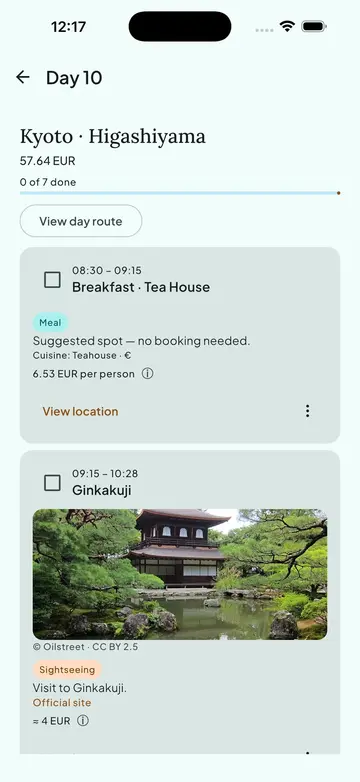
Joru's answer is that every stop existed in open data before the model said a word — coordinates from OpenStreetMap, area guides from Wikivoyage, forecasts from Open-Meteo — and that the budget and the order of the stops are computed rather than guessed. Ask the same question of anything else you are considering.

Try the on-device one

Free to download and free to plan, with no account. The questions page covers what Premium adds and what the app cannot do.

Home