
Skip to content
JoruJoru
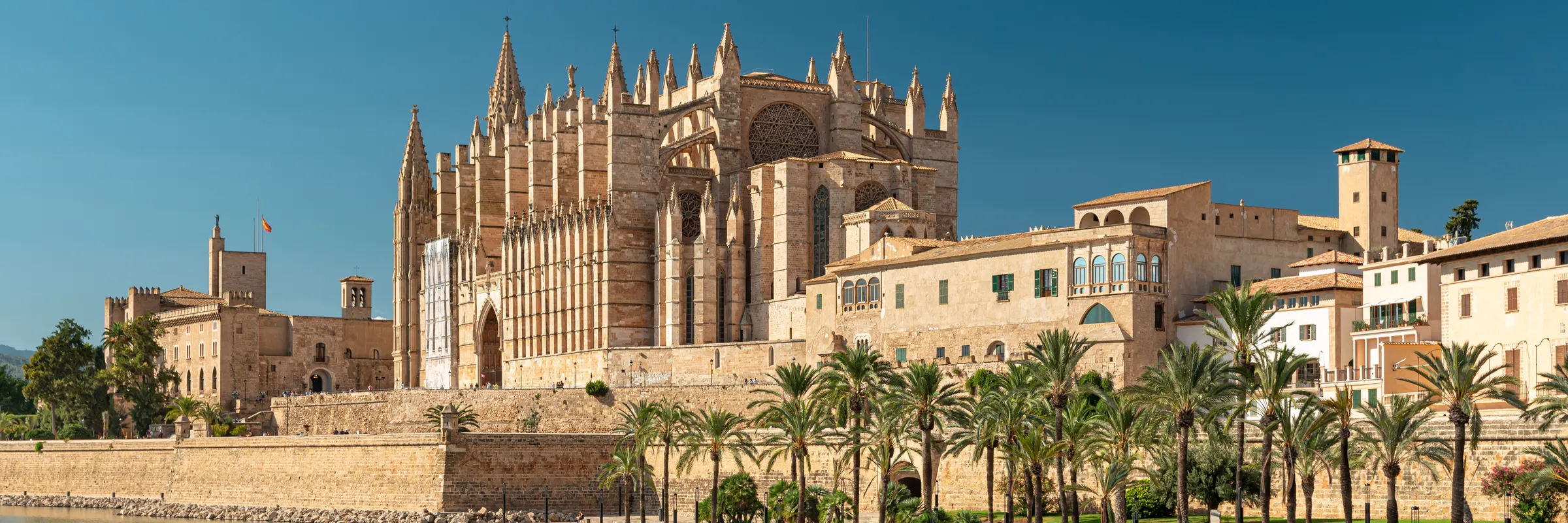
Mallorca: Palma's cathedral and the Almudaina palace above the sea walls

Balearic Islands, Spain

Mallorca: how many days you need and the best months to go

Photo: Jorge Franganillo · CC BY 4.0

Mallorca is much more than the package-holiday resorts it is known for across northern Europe. Palma, its capital, is a real city, with a great Gothic cathedral rising from the old sea walls, an old town of palaces with hidden courtyards, and markets where the island does its shopping. Along the whole north-west coast runs the Serra de Tramuntana, a range of limestone mountains whose terraces, olive groves and stone villages are a World Heritage cultural landscape, crossed by a winding road and an old wooden train. The east and south have coves of turquoise water between pine-covered rocks, caves with underground lakes and long beaches of white sand. The planning problem is size and summer. The island is about a hundred kilometres across, each of its regions an hour or more from the others by road, and in July and August the roads to the famous coves and capes jam, their car parks fill, and some of them are closed to cars by day. Where you sleep, and when you go, decide the trip.

Short answers

What people ask before booking

How many days do you need in Mallorca?

Mallorca needs four days: one for Palma — the cathedral, the old town and Bellver Castle — one or two for the Tramuntana mountains, with the train to Sóller and the villages of Valldemossa and Deià, and one for the coves of the south-east or the caves of Drach. Six days add the north, Formentor and time on the beaches.

What is the best month to visit Mallorca?

May and June — Warm, green and before the peak. September and October — A warm sea and fewer people.

Work out how many hours you will have in Mallorca on your dates
When to go, and what each month costs you

Mallorca has a Mediterranean climate: hot, dry summers, mild winters, and most of the rain in autumn. The sea is warm enough for most swimmers from June to October, and the peak of July and August brings heat, crowds and the highest prices. The months either side are the best.

  1. January: Worth it, but
  2. February: Worth it, but
  3. March: Worth it, but
  4. April: Worth it, but
  5. May: Go now
  6. June: Go now
  7. July: Worth it, but
  8. August: Worth it, but
  9. September: Go now
  10. October: Go now
  11. November: Worth it, but
  12. December: Worth it, but
  • May and June

    Go now

    Warm, green and before the peak

    Warm, sunny days, long evenings and the countryside still green. The sea warms through June, the coves are calmer than in summer, and the mountains are still pleasant for walking.

  • September and October

    Go now

    A warm sea and fewer people

    The sea still warm after the summer, the heat easing and the crowds thinning. Autumn storms can bring a day of heavy rain, more often in October; the walking season in the mountains begins again.

  • July and August

    Worth it, but

    Hot, full and dear

    Hot days, warm nights and a warm sea, with the island at its fullest. The famous coves fill early, the roads to them jam, and the lighthouse road at Formentor is closed to cars by day. Book well ahead, and do the sightseeing early.

  • November to April

    Worth it, but

    Mild, quiet and half closed

    Mild days with cool nights and some rain, the best season for walking and cycling in the mountains, and the almond blossom from late January into February. Many resort hotels and restaurants close, but Palma stays alive, with the bonfires and festivities of Sant Antoni and Sant Sebastià in January.

What to pack for Mallorca, month by month

How many days Mallorca needs

Four days give a fair picture. One for Palma: the cathedral, the old town, the market and the castle of Bellver above the bay. One or two for the Tramuntana: the train to Sóller, the villages of Valldemossa and Deià, and the road over the mountains. One for a coast: the coves of the south-east, or the caves of Drach on the east coast.

Six days let you have the beaches as well. Add the peninsula of Formentor and the old towns of Pollença and Alcúdia in the north, a day's walk on the long-distance path through the mountains, the boat to the cove of Sa Calobra, or simply a day by the sea. Many visitors split the stay between Palma and a second base on the coast.

How the island is arranged

Mallorca is roughly a square about a hundred kilometres across. Palma, with the airport, sits on a wide bay in the south-west; the Serra de Tramuntana runs along the whole north-west coast; a flat interior of almond and olive groves, vineyards and market towns fills the centre; and the east and south are low coasts of coves and beaches.

  • Palma — the capital, with nearly half the island's people: the cathedral, the old town, the port and the beaches of the bay.
  • The Serra de Tramuntana — the mountains of the north-west, with Valldemossa, Deià, Sóller and the road down to Sa Calobra.
  • The north — the bays of Pollença and Alcúdia, their old hill and walled towns, and the peninsula of Formentor.
  • The east coast — coves between pine-covered rocks, the caves of Drach near Porto Cristo, and resort towns.
  • The south — the coves around Santanyí, the natural park of Mondragó and the long dune beach of Es Trenc.
  • The interior — market towns, vineyards and hills crowned by sanctuaries, with weekly markets and the almond blossom of late winter.

Where to stay, and what each area costs you

Palma is the best base without a car, and for short stays: the buses and the Sóller train start there, and the city has the best restaurants. With a car, a second base in the mountains or on a coast saves long drives. The resort strips of the bay of Palma and the east coast are cheaper and built for beach holidays, which is what they are good for.

Prices peak in July and August and are high from May to October; many hotels outside Palma close from November to March. The Balearic Islands charge a tourist tax per person and per night, higher in the summer season.

AreaWho it suitsThe catch
Palma's old townFirst visits and short stays: the cathedral, the restaurants, and the buses and the train to everywhere.Dear and busy in summer, with cruise passengers by day, and no beach on the doorstep.
Santa Catalina and the seafrontA lively old fishermen's district west of the old town, with its market, bars and the promenade.Noisy at night, and parking is hard.
Sóller and the mountainsWalkers and slow stays: stone villages, the train and the tram, and the port of Sóller.Winding roads to everything else, and few beaches.
The north: Pollença and AlcúdiaFamilies and long stays: calm bays, long beaches, old towns, and Formentor close by.An hour from Palma and the airport, and built up with resorts in parts.
The south-east covesSwimming: the clear water of the coves of Santanyí and Mondragó, from villages and small resorts.You need a car, and the famous coves are crowded in summer.

Compare these areas against your priorities

Getting there, and getting around

Palma's airport is one of the busiest in Spain, with flights from all over Europe and a bus into the city in about twenty minutes. Ferries arrive from Barcelona, Valencia and Dénia, and link Mallorca with the other Balearic islands.

A hire car is the practical way to see the island, and the only way to many coves and villages. Without one, the island's buses run from Palma to most towns, trains go inland to Inca, Sa Pobla and Manacor, and the old wooden train climbs through the mountains to Sóller.

  • The Sóller train has run between Palma and Sóller since 1912, with a tram on to the port. It is a ride more than a transport, priced as one, and the morning trains fill in summer.
  • The road to Cap de Formentor is restricted by day from mid-May to mid-October: cars may go only as far as the beach car park, while it has spaces, and a shuttle bus runs on to the lighthouse.
  • The road down to Sa Calobra is a famous ribbon of hairpins shared with coaches and cyclists; the boat from the port of Sóller is the calmer way in.
  • Leave the car outside Palma's old town, where traffic is restricted to residents.

The cathedral, the mountains and the coves

Palma's cathedral, La Seu, rises from the old sea walls over the bay: a Gothic church begun after the Christian conquest of 1229, with one of the tallest naves in Europe and an immense rose window. Gaudí reworked its interior in the early twentieth century, and in this century the painter Miquel Barceló covered a side chapel in ceramic. Give it a morning, with the royal palace of the Almudaina next door.

  • Bellver Castle — a round Gothic castle of the fourteenth century on a wooded hill above Palma, with the whole bay below.
  • Valldemossa and Deià — a stone village around the old charterhouse where Chopin and George Sand spent a winter, and the hillside village of writers and painters above the sea.
  • Sa Calobra and the Torrent de Pareis — a cove at the mouth of a deep gorge, reached through tunnels in the rock from the end of the road.
  • The caves of Drach — caverns near Porto Cristo with an underground lake, where the visit ends with a short concert on the water.
  • Formentor — the peninsula of cliffs at the island's northern tip, with viewpoints, a beach shaded by pines and the lighthouse at the end.
  • The coves of the south-east — Caló des Moro, Cala Mondragó and dozens of others: turquoise water between pine-covered rocks, best early in the morning.

How eating works here

Mallorca's own food is country food: pork in every form, vegetables cooked slowly in olive oil, bread rubbed with tomato, and the spiral pastry the island is known for. The resorts serve the food of their visitors; to eat Mallorcan, look to the restaurants and markets of Palma, and to the old cellar restaurants and village bars inland.

Spanish hours apply, a little earlier in the resorts: lunch from one or two, dinner from eight or nine. The menu of the day at lunch is the best value on the island.

  • The weekly markets of the inland towns, Sineu's on Wednesdays above all, sell produce, cheese and sausage.
  • The island's wines, from Binissalem and the plain, are worth ordering.
  • The herb liqueur comes sweet, dry or mixed, and is drunk after meals.
  • Tipping is optional: rounding up is enough.

Where to eat in Mallorca, and what to order

Mallorca's table is simple and rich: a spiral pastry for breakfast, a soft paprika sausage, bread rubbed with tomato and oil, and a bake of summer vegetables, with a glass of the herb liqueur to finish. Look for them in Palma's markets and in the villages, not on the resort promenades.

  • Ensaïmada

    What to order

    The spiral pastry of the island

    A coil of light, sweet dough made with lard, baked and dusted with icing sugar, plain or filled with pumpkin jam or cream. It has a protected name, and visitors carry it home in large flat boxes on every flight. Eat it for breakfast with coffee or hot chocolate.

    Check it on Wikidata
  • Sobrassada

    What to order

    The soft paprika sausage

    A soft, spreadable cured sausage of pork and paprika, deep red and rich, spread on bread or cooked with honey. Its protected name covers the sausage made on the island, including one made only from the island's native black pig.

    Check it on Wikidata
  • Tumbet

    What to order

    The bake of summer vegetables

    Layers of fried potato, aubergine and red pepper under a tomato sauce, served in a clay dish. It is the summer vegetable dish of Mallorca, eaten on its own or alongside fish or meat.

    Check it on Wikidata
  • Pa amb oli

    What to order

    Bread with tomato and oil

    A slice of the island's dense bread rubbed with the small hanging tomatoes of Mallorca, drizzled with olive oil and salt, and topped with cheese or cured ham. It is the snack of every bar, and the plainest way to taste the island's oil and tomatoes.

    Check it on Wikidata
  • Hierbas de Mallorca

    What to order

    The herb liqueur after the meal

    An anise liqueur flavoured with the herbs of the island, such as fennel, rosemary and lemon verbena, made sweet, dry or mixed. It has a protected name, and many restaurants pour a glass after the meal.

    Check it on Wikidata

Things that change the trip

  1. Hire a car, or base yourself in Palma and use the buses and the Sóller train.
  2. Book the morning Sóller trains in summer.
  3. Reach the famous coves early, before the car parks fill.
  4. Check the dates of the Formentor restrictions before you drive out.
  5. Take the boat to Sa Calobra from the port of Sóller instead of the road at peak hours.
  6. In winter, check that your hotel and the restaurants around it are open.

Plan Mallorca with the other islands

A trip of more than three days, or one that joins Mallorca with Menorca, Ibiza or Barcelona and the ferries and flights between them, is what Premium is for. The free version covers one destination of up to three days.

Destinations