
Skip to content
JoruJoru
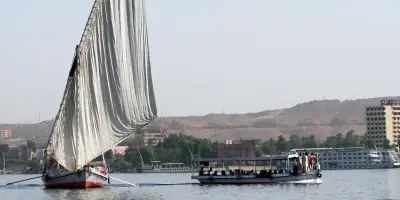
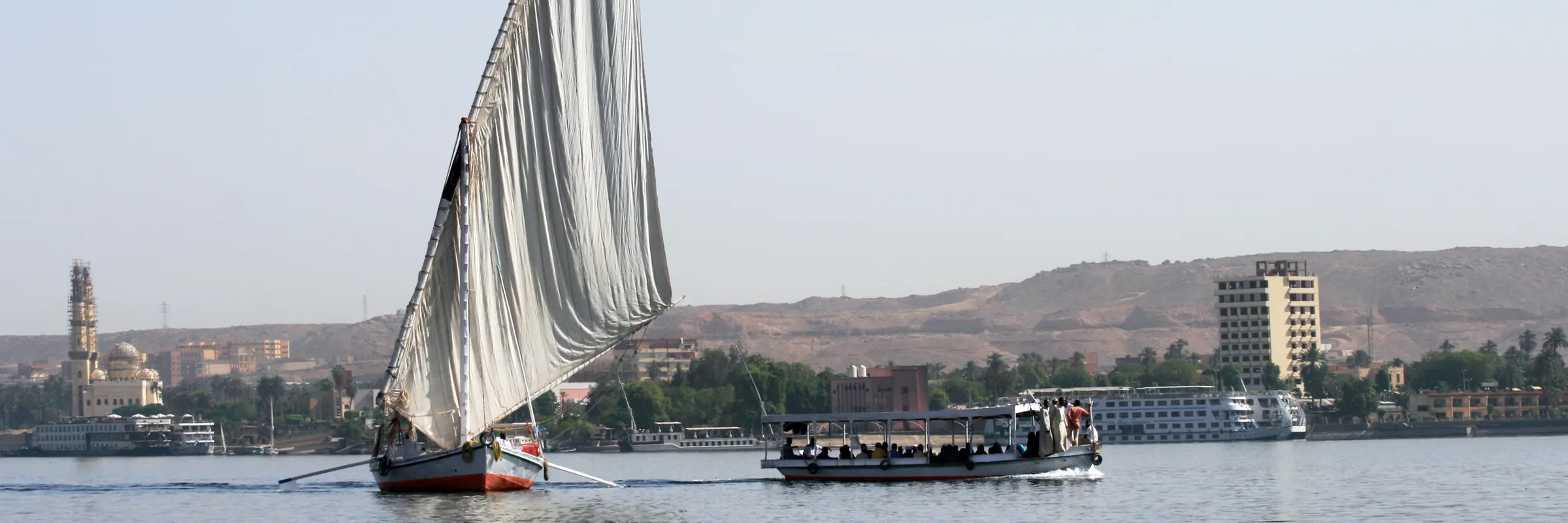
Aswan: a felucca under sail on the Nile
Photo: Karelj · Public domain
Aswan, Egypt

Aswan: how many days you need and the best months to go

Aswan was the edge of Egypt: the last town before Nubia, the quarry that supplied the obelisks, and the point where the river stops being navigable. It is smaller, slower and hotter than Luxor, and its reputation rests on three things — the river itself, which is at its most beautiful here; the Nubian culture that the town is built on; and the fact that when the High Dam flooded this valley in the 1960s, an international rescue moved the temples stone by stone to higher ground. Two days covers it. Three if Abu Simbel is on the list.

Short answers

What people ask before booking

How many days do you need in Aswan?

Aswan needs two days for the town, the island temples and an afternoon on the river, and a third only if you are going to Abu Simbel, which is a full day of driving either way.

What is the best month to visit Aswan?

November and December — Warm days, cool nights, and the light at its best. January and February — The coolest months, and genuinely cold at night.

Which months are worth avoiding in Aswan?

April and May — The heat arrives, and so does the wind. June, July, August and September — The hottest inhabited place in Egypt, at its hottest.

How many days Aswan needs

Two days is the honest figure for the town and its immediate sights: the island temple, the unfinished obelisk, a Nubian village and an afternoon on the water, which is what people actually remember.

The third day is Abu Simbel, and it is a genuine full day: the temples are around 280 kilometres south, close to the Sudanese border, and the round trip by road takes most of the daylight. If you are not doing that, two days is right, and Aswan is better as a slow stop than a busy one.

The dam, and why several temples are in the wrong place

The Aswan High Dam was completed in 1970 and it did what it was built to do: it ended the annual Nile flood, generated a large share of Egypt's electricity and created Lake Nasser, one of the largest reservoirs on earth. It also drowned a stretch of Nubia, displacing tens of thousands of Nubians whose villages are now under the lake. That displacement is not a historical footnote here; it is within living memory and it shapes the town.

The flooding would also have destroyed a series of ancient temples, and what followed was one of the largest heritage operations ever attempted. Between 1960 and 1980 an international campaign cut Abu Simbel into more than a thousand blocks and rebuilt it sixty metres higher, moved the Philae temples to a different island entirely, and relocated several smaller sites to other countries. So when a temple here feels oddly placed, it usually is: it is not where it was built.

What to see, and in what order

Aswan's sights are spread along and across the river, which is why the boat matters more than the taxi. A felucca — the lateen-rigged sailing boat that has worked this river for centuries — is not a tourist add-on here but the sensible way to move between the islands.

The order that works is river first, monuments second. The light on the water is best early and late, and the temples are hot and unshaded in the middle of the day.

  • Philae — the temple of Isis, moved block by block to a neighbouring island in the 1970s after the original was half-submerged. Reached only by boat, and the finest thing in Aswan.
  • The unfinished obelisk — a single shaft still lying in the granite quarry where it cracked. It would have been the largest obelisk ever raised, and it explains how they were cut better than any museum.
  • Elephantine Island — inhabited since the Old Kingdom, with a ruin field, a museum and two Nubian villages on it. The oldest continuously occupied place in the city.
  • The Nubian Museum — the collection assembled from what the rescue campaign saved, and the clearest account anywhere of what was lost under the lake.
  • Abu Simbel — four seated colossi cut into a cliff for Ramesses II, and the temple whose relocation made the whole campaign famous. A full day, and worth it.

Getting to Abu Simbel

There are two ways and they suit different trips. The road convoy leaves Aswan long before dawn, takes about three and a half hours each way across open desert, and gives you an hour or two at the site before turning round. It is long, it is cheap, and almost everyone does it this way.

The alternative is to fly, which turns the day into a few hours rather than all of it, or to stay the night at Abu Simbel itself — a small place with a handful of hotels — which is the only way to see the temples without the mid-morning crowd. The site also stages a sound and light show in the evening that only the overnight option makes possible.

  • Leave before dawn whichever way you go. By eleven the façade is in full sun and the interior is packed.
  • Photography rules inside the temples change from time to time, and are enforced at the door. Assume a separate ticket for a camera.
  • Twice a year the rising sun reaches the innermost sanctuary and lights three of the four statues. The dates shifted by a day when the temple was moved, which tells you how precise the original alignment was.
  • It is hotter there than in Aswan, and there is no shade at the site at all.

Nubia, and why it matters here

Aswan is where Egypt becomes Nubia, and the distinction is real rather than decorative. Nubians are a distinct people with their own languages, architecture and music, whose homeland straddles the modern border with Sudan — and much of that homeland is now under Lake Nasser. The villages you can visit on Elephantine and on the west bank were rebuilt after the flooding.

The architecture is the visible part: bright blue and ochre houses, domed roofs that keep interiors cool, and painted facades. Visiting a Nubian village is a normal and welcomed thing to do here, and the good version involves being invited into a house for tea rather than photographing the doorways from a boat.

Practical things that catch visitors

Aswan is the most relaxed of Egypt's tourist towns and the hassle is correspondingly lighter than in Luxor or Cairo — but the felucca captains, the caleche drivers and the shopkeepers all negotiate, and the first price is an opening position rather than a price. Agreeing the fare, the duration and the destination before you step onto a boat prevents almost every dispute that happens here.

The other thing is the sun. This is the hottest inhabited part of Egypt, the humidity is very low, and dehydration arrives without the warning signs people expect from a humid climate. Drink far more than you feel you need.

  • Agree the price, the route and the length of the trip before boarding a felucca. All three, explicitly.
  • Tipping is expected everywhere and in small amounts. Carry a supply of small notes; it removes most awkwardness.
  • Cover your shoulders and knees, particularly away from the hotels. It is a conservative town and it is also sun protection.
  • The overnight train from Cairo is a real option and runs to Aswan directly, which most visitors do not realise.

What to eat in Aswan, and where

Egyptian food is bean-based, cheap and much better on the street than in a hotel. The staples here are the same as in Cairo, with Nubian cooking alongside them — spicier, more likely to involve fish from the river, and mostly eaten in homes rather than restaurants.

  • Ful medames

    What to order

    Breakfast, and the national dish nobody mentions

    Fava beans stewed overnight in a narrow-necked pot and served mashed with oil, lemon, cumin and whatever else the stall has. It has been eaten in Egypt since the pharaohs, and it is what the country actually runs on — cheap, filling and eaten with bread instead of cutlery. Order it from a cart in the morning.

    Check it on Wikidata
  • Ta'ameya

    What to order

    The other breakfast, and the Egyptian version

    Fritters made from crushed fava beans rather than chickpeas, which is the Egyptian recipe and the older one. They are greener inside and lighter than the Levantine version, served in bread with salad and tahina. In Egypt they are called ta'ameya, and asking for falafel gets you the same thing.

    Check it on Wikidata
  • Koshari

    What to order

    The national dish that is entirely carbohydrate

    Rice, lentils and macaroni in one bowl, topped with tomato sauce, fried onions and a garlic-vinegar dressing, with chickpeas over the lot. It is a nineteenth-century invention that became the food of the entire country, sold from dedicated shops that make nothing else. Ask for the chilli sauce on the side.

    Check it on Wikidata
  • Mulukhiyah

    What to order

    The soup people either love or refuse

    Jute leaves cooked into a green soup with garlic and coriander, served over rice with chicken or rabbit. The texture is the dividing line — it is deliberately viscous, which is the point of it — and it is one of the oldest dishes still eaten in Egypt. Try it once; you will know immediately.

    Check it on Wikidata
  • Karkadeh

    What to order

    The drink to order in the afternoon

    Dried hibiscus flowers steeped into a deep red drink, served hot in winter and iced in summer. It is the Nubian and Upper Egyptian drink rather than a national one, and Aswan is where it is best. Sharp, sweetened heavily, and better cold than any bottled soft drink in this heat.

    Check it on Wikidata
  • Elephantine

    Where to look

    Where to eat with the river in front of you

    The island in the middle of the Nile opposite the town, inhabited since the Old Kingdom and holding two Nubian villages among the ruins. The small guesthouses and family kitchens here serve the best food in Aswan, usually a set meal, usually on a roof. Reached only by boat, which is the whole appeal.

    Check it on Wikidata

When to go, and what each month costs you

Aswan is the hottest inhabited place in Egypt and one of the driest on earth — rain here is measured in millimetres per decade. The year divides cleanly into a season when you can walk around and a season when you cannot, and everything else about the trip follows from that.

  • November and December

    Go now

    Warm days, cool nights, and the light at its best

    The ideal window: comfortable in the sun, cold enough after dark to want a jacket, and the river at its most photogenic. This is high season for the Nile cruises and prices reflect it. Book the Abu Simbel logistics ahead.

  • January and February

    Go now

    The coolest months, and genuinely cold at night

    The most comfortable walking weather of the year, with temperatures that can drop sharply once the sun goes down — a surprise to anyone who packed for Africa. Everything is open and running. Peak season, and it earns it.

  • March

    Worth it, but

    Still workable, and warming fast

    The last comfortable month. Mornings are fine, the middle of the day is starting to be work, and the crowds are thinning. Prices drop as the month goes on. Ramadan moves about eleven days earlier each year, so check whether it falls here: daytime eating options thin out and evenings become the best part of the day.

  • October

    Worth it, but

    Coming off the peak, and cheaper for it

    Still hot, particularly early in the month, and getting better every week. Prices sit below November and the sites are quiet. A reasonable compromise if your dates are fixed and you plan around the middle of the day.

  • April and May

    Think twice

    The heat arrives, and so does the wind

    Temperatures climb steeply and the khamsin — a hot, sand-carrying wind from the desert — blows intermittently through the spring, cutting visibility and coating everything. Prices fall a long way. Sightseeing becomes a morning-only activity.

  • June, July, August and September

    Think twice

    The hottest inhabited place in Egypt, at its hottest

    Regularly above forty-five degrees, with no shade at any of the sites and none at Abu Simbel at all. Hotels are nearly empty and priced accordingly, and the light is spectacular at dawn. Everything after about nine in the morning becomes genuinely unwise, which is most of a sightseeing day.

Things that change the trip

  • Agree the price, the route and the duration before you get on a felucca. All three, out loud, before you step aboard.
  • Leave before dawn for Abu Simbel whichever way you travel. The façade is in full sun and full of people by eleven.
  • Several temples here are not where they were built. Philae and Abu Simbel were moved in the 1960s and 70s to escape the lake.
  • Drink far more water than you think you need. The humidity is so low that you will not feel yourself sweating.
  • Take the overnight train from Cairo at least one way. It runs directly to Aswan and most visitors never consider it.
  • Eat on Elephantine Island rather than on the corniche. The guesthouses there cook better than the restaurants across the water.

Plan Aswan and the Nile above it

A trip that adds Luxor, Abu Simbel, a Nile cruise or the run north to Cairo, with the trains, flights and timings between them, is exactly what Premium is for. The free version covers one destination of up to three days.

Destinations