Skip to content
JoruJoru
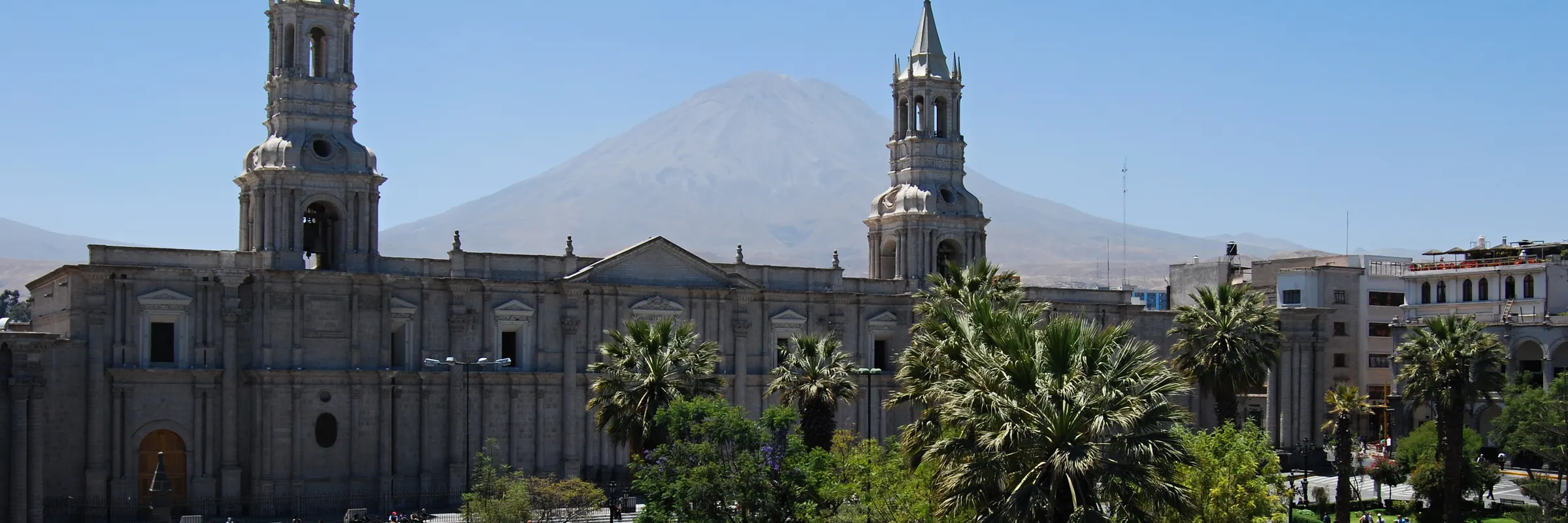
Arequipa: The cathedral on the Plaza de Armas, with El Misti behind
Photo: Pavel Špindler · CC BY 3.0
Peru

Arequipa: how many days you need and the best months to go

Arequipa is built out of the mountain above it: sillar, a white volcanic rock quarried nearby, which is why the whole old centre is the same pale colour and why it glares in the sun. It sits at about 2,300 metres — high, but a thousand metres lower than Cusco — which makes it the single most useful acclimatisation stop in southern Peru. Two days does the city. Four takes in the Colca canyon properly, and that is the version worth doing.

Short answers

What people ask before booking

How many days do you need in Arequipa?

Arequipa needs two days for the white-stone centre and four to add the Colca canyon properly, sleeping in the valley. Come here before Cusco, not after: it sits around 2,300 metres against Cusco's 3,400, and the canyon is higher still, over a pass above 4,000.

What is the best month to visit Arequipa?

April and May — Just after the rains, before the crowds. September, October and November — Dry, warm days and the peak season gone.

Which months are worth avoiding in Arequipa?

January and February — The wet months, and the volcanoes hidden.

How many days Arequipa needs

Two days covers the city itself, and covers it well: the Santa Catalina monastery and the main square on one, the Andean sanctuaries museum, the sillar quarries and a long lunch on the other. The old centre is compact, flat by Andean standards and genuinely walkable, and the volcanoes are visible from most of it.

Four days is the version that includes the Colca canyon, which is the reason most people come south at all — two days there, with a night in the valley, rather than the day trip that leaves at three in the morning and gives you twenty minutes at the viewpoint. If you only have three days, do the city in one and the canyon in two, not the other way round.

The altitude, and why the order of your trip matters

Arequipa is at roughly 2,300 metres. Cusco is at about 3,400 and Puno, on Lake Titicaca, is close to 3,800. That difference is the reason to come here first: arriving in Arequipa from the coast and spending two or three days is a genuinely gentler adjustment than flying straight into Cusco, and it makes the rest of the route more comfortable.

It also sets a trap. The Colca canyon is higher than Arequipa, not lower — the road crosses a pass well above 4,000 metres and the viewpoints sit around 3,300 — so a canyon trip on your first morning in the country is the worst possible plan. Give the city a couple of days first. Drink more water than feels necessary, go easy on alcohol the first night, and treat a headache as a signal rather than an inconvenience.

  • Santa Catalina monastery — a walled religious city inside the city, founded in 1579 and effectively sealed off from the outside world until 1970. The single best thing here.
  • Plaza de Armas — the arcaded square with the cathedral along one whole side, and El Misti standing behind it. Rebuilt repeatedly after earthquakes.
  • Museo Santuarios Andinos — home of the Inca mummy found frozen on Ampato in 1995. She is rotated off display for conservation, so check before going for her.
  • The sillar quarries — the white rock the city is made of, still being cut just outside it. Explains the architecture in about ten minutes.
  • Colca canyon — one of the deepest canyons on earth, with Andean condors at the main viewpoint in the morning. Two days, not one.

A city made of one rock, on a fault line

Sillar is ignimbrite: compacted volcanic ash, soft enough to be carved with hand tools and pale enough to have given the city its nickname. Every important building in the old centre is made of it, which is why Arequipa looks unified in a way that few colonial cities do, and why the carving on the church façades is so deep and so strange — a local style mixing Spanish baroque with Andean plants, animals and faces.

The other half of the story is that the same volcanic geology means earthquakes. The cathedral has been damaged and rebuilt more than once, most recently after a major quake in 2001 that brought down one of its towers, and many buildings carry visible repairs. It is not a reason to worry; it is the reason the architecture is low, thick-walled and vaulted, and knowing it makes the city legible.

El Misti and the other two

Three volcanoes stand over the city: El Misti, the symmetrical cone at 5,822 metres, with Chachani to its left and the ragged Pichu Pichu to its right. El Misti is the postcard and is climbable without technical skill, but it is a serious high-altitude effort that takes two days and requires proper acclimatisation — not something to arrange on impulse.

For most visitors the volcanoes matter as weather and as light. They are clearest in the dry months and often hidden by afternoon cloud in the wet ones, so a morning window is the reliable one for photographs and views. The clarity of the light at this altitude is also why the sun burns much faster than the temperature suggests: hat, sunglasses and sunscreen are not optional here even on a cool day.

Practical things worth knowing

Arequipa has an airport with connections to Lima and Cusco, and the overland route from the coast or from Puno is long but scenic. The bus to the Colca valley takes several hours each way and climbs a high pass, which is the argument for sleeping in the valley rather than doing it in a day.

Two more. The tap water is not for drinking, and at this altitude you will want a lot of water, so plan for it. And the good food is at lunch, not dinner — the traditional picanterías are lunch places, they cook a different dish depending on the day of the week, and several of the city's best are away from the main square in the old neighbourhoods. Eating your main meal in the middle of the day is the local rhythm and the better one here.

What to eat in Arequipa, and where

Arequipa takes its food more seriously than anywhere else in Peru outside Lima, and it does it in a specific institution at a specific hour. The picantería is a lunch place with a dish for each day of the week — knowing which day you are on tells you what to order.

  • Picantería

    Institution

    The place, not the dish

    A picantería is not a restaurant name but a type: a traditional Arequipa eating house, open for lunch, with a wood or clay stove, big shared tables and chicha in a jug. The picantería has formal recognition as cultural heritage of Peru, which is unusual for a category of restaurant rather than a building. Each one cooks a rota by weekday, so ask what today's dish is before you order anything else.

    Check it on Wikidata
  • Rocoto relleno

    What to order

    The dish that belongs to this city

    A rocoto is a thick-walled red pepper that looks like a small sweet pepper and is genuinely hot. Stuffed with minced beef, olives and egg, capped with cheese and baked, it is Arequipa's flagship dish and it is served with a slab of potato cake alongside. The heat is deliberately reduced by soaking, but it is still there — this is not a mild dish and it is not pretending to be.

    Check it on Wikidata
  • Chupe de camarones

    What to order

    The Friday dish, and the season behind it

    A thick soup of river prawns with milk, egg, corn and potato, and it is the Friday dish — the day traditionally without meat, in a city that organised its cooking around the church calendar. There is a second layer to the timing: river prawn fishing is closed for part of the early year to let them breed, so the classic version is a dry-season dish. Ask rather than assume in January and February.

    Check it on Wikidata
  • Adobo arequipeño

    What to order

    The Sunday breakfast

    Pork marinated overnight in chicha, then cooked slowly in a wood-fired oven with onion and rocoto, and eaten in the morning with bread — specifically on Sunday, and specifically as breakfast. It comes with a small glass of the marinade's alcohol on the side. Places that serve it open early and sell out; this is one of the few things worth setting an alarm for on a Sunday.

    Check it on Wikidata
  • Queso helado

    What to order

    The dessert whose name lies

    It is not cheese and there is no cheese in it. It is milk frozen in a shallow pan and scraped up in layers, flavoured with cinnamon and coconut, sold from carts in the main square and in the markets. The name comes from the way the frozen block looks, which fools every visitor once. Cold, dense and better than it sounds.

    Check it on Wikidata

When to go, and what each month costs you

Arequipa is one of the sunniest cities in Peru and its year is a dry season and a wet one rather than four seasons. The rains come in the southern summer, and they arrive as afternoon cloud rather than all-day drizzle — which still matters, because the volcanoes disappear into it.

  • April and May

    Go now

    Just after the rains, before the crowds

    The best window of the year. The wet season has ended, the countryside around the city is still green from it, the air is clear and the volcanoes are visible all day. This is before the July and August peak, so the canyon is quieter and prices are lower. Nights are cool but not yet cold.

  • September, October and November

    Go now

    Dry, warm days and the peak season gone

    The other good window, and the warmer of the two: clear dry days, mild nights, and the high-season crowds gone home. Rain becomes a possibility again towards the end of November, arriving as afternoon cloud. If you want the canyon without the tour-bus convoy, this is the stretch to pick.

  • June, July and August

    Worth it, but

    The clearest skies, the coldest nights, the most people

    The driest and most reliable months, and therefore Peru's high season: full hotels, full buses to Colca, and higher prices everywhere. The trade-off is temperature rather than rain — nights are cold and the canyon viewpoints at dawn are genuinely freezing, which surprises people who packed for a tropical country. Book the canyon in advance in these months.

  • December

    Worth it, but

    The rains starting, and the holidays with them

    The wet season is beginning: mornings are usually clear and clouds build in the afternoon, so plan sightseeing early. The Christmas and New Year period fills hotels with domestic travellers and prices rise for a couple of weeks around it. Between those weeks, December is quiet and reasonable.

  • March

    Worth it, but

    The rains ending, the landscape at its greenest

    The tail of the wet season, and the countryside is at its best-looking of the year. Afternoon rain is still likely and mountain roads can be affected, so keep the canyon plan flexible. Late March is close to April in quality and cheaper, which makes it a decent gamble.

  • January and February

    Think twice

    The wet months, and the volcanoes hidden

    The core of the rainy season: cloud builds every afternoon, the volcanoes are often invisible for days, and roads to the Colca canyon are at their most likely to be disrupted by rain and landslides. It is also the part of the year when river prawn fishing is restricted, so the city's most famous soup may not be on. Cheap and green, and the wrong time for the canyon.

Things that change the trip

  • Come here before Cusco, not after. Arequipa is around 2,300 metres against Cusco's 3,400, and two days here makes the rest of the route easier.
  • The Colca canyon is higher than the city, over a pass above 4,000 metres. Do not make it your first morning in the Andes.
  • Give the canyon two days and sleep in the valley. The one-day version leaves before dawn and buys you twenty minutes at the viewpoint.
  • Eat your main meal at lunch. The picanterías are lunch places and they cook a different dish depending on the day of the week — ask what today's is.
  • The sun at this altitude burns much faster than the temperature suggests. Hat and sunscreen on cool days too.
  • Look at the volcanoes in the morning. In the wet months the afternoon cloud hides them completely, and mornings are the reliable window all year.

Plan Arequipa and southern Peru

A trip beyond four days, or one that links Arequipa with Colca, Puno and Cusco — with the altitude gain, the bus times and the wet season worked out around it — is exactly what Premium is for. The free version covers one destination for up to three days.

Destinations