
Skip to content
JoruJoru
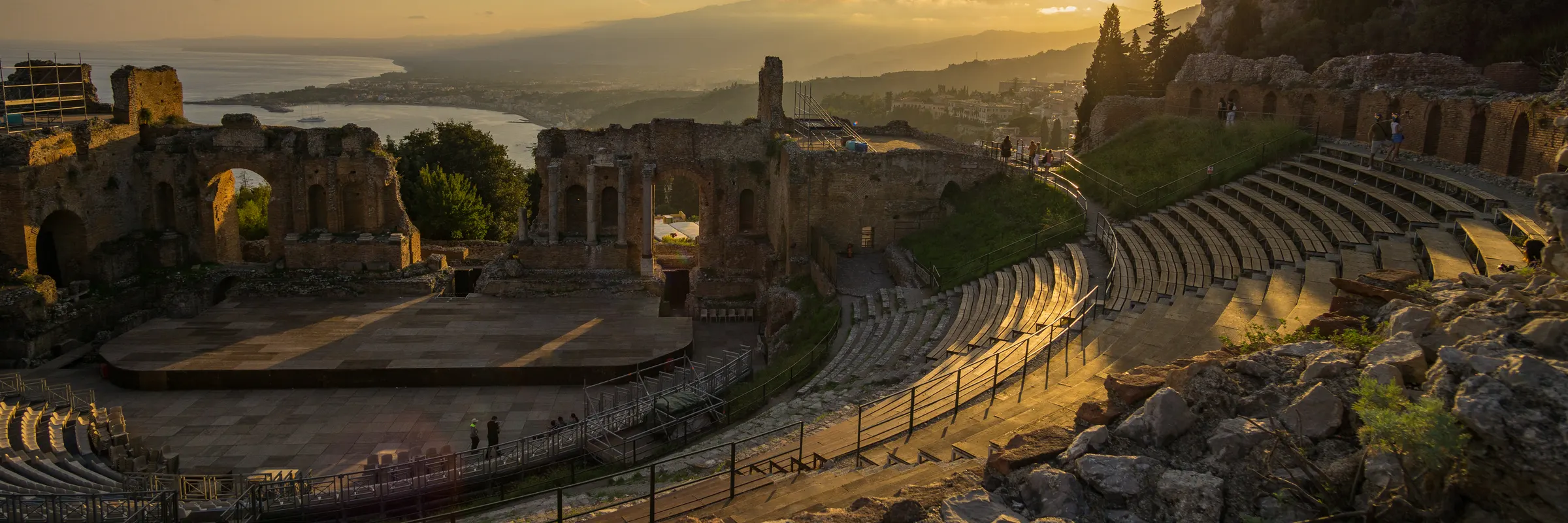
Taormina: The Greek theatre of Taormina at sunset, above the coast

Sicily, Italy

Taormina: how many days you need and the best months to go

Photo: Radek Kucharski · CC BY 2.0

Taormina has been famous for its view for more than two thousand years. The Greeks built a theatre on the edge of its cliff, and from the top of the seats the stage still frames the sea and the snow-capped cone of Etna, the highest active volcano in Europe, smoking on the horizon. In the nineteenth century writers, painters and aristocrats from the north discovered it, built villas and gardens, and made it Sicily's first resort. Today its main street of medieval palaces, churches and pastry shops runs between two old gates along the hillside, and far below, a cable car drops to coves of pebbles and clear water and the little island of Isola Bella. The planning problem is the hill and the crowd. The town is small, steep and closed to most traffic; parking is at its edges; and by day tour coaches and cruise passengers fill the main street. Sleep in Taormina, see it early and late, and give a day to Etna.

Short answers

What people ask before booking

How many days do you need in Taormina?

Taormina needs one day for the Greek theatre, the main street, the gardens and the cable car down to Isola Bella, and a second for Etna, by tour or by car. A third day adds the Alcantara gorges, the beach at Giardini Naxos or Catania. Sleep in the town to see it without the day-trippers.

What is the best month to visit Taormina?

April to June — Spring flowers and the sea warming. September and October — A warm sea and the harvest on Etna.

Work out how many hours you will have in Taormina on your dates
When to go, and what each month costs you

Taormina has a mild Mediterranean climate: hot, dry summers, mild winters with some rain, and long, warm springs and autumns. The season runs from Easter to October; in winter the town is quiet and much of it closes, and Etna is often snow-capped.

  1. January: Worth it, but
  2. February: Worth it, but
  3. March: Worth it, but
  4. April: Go now
  5. May: Go now
  6. June: Go now
  7. July: Worth it, but
  8. August: Worth it, but
  9. September: Go now
  10. October: Go now
  11. November: Worth it, but
  12. December: Worth it, but
  • April to June

    Go now

    Spring flowers and the sea warming

    Warm days, the gardens in flower and Etna still white at the top. Easter, whose date moves every year, opens the season; by June the sea is warm and the theatre's summer programme begins.

  • September and October

    Go now

    A warm sea and the harvest on Etna

    The sea still warm after the summer, the heat easing and the grape harvest on the slopes of the volcano. The best time to combine the town, the sea and Etna.

  • July and August

    Worth it, but

    Hot, full and festive

    Hot days, warm nights and the town at its fullest, with concerts and the film festival in the Greek theatre. The coves and the main street are crowded; visit early and late, and book well ahead.

  • November to March

    Worth it, but

    Quiet, mild and half closed

    Mild days with some rain, cool nights and snow on Etna. Many hotels and restaurants close, but the town is calm and the theatre almost empty; too cool for most people to swim.

What to pack for Taormina, month by month

How many days Taormina needs

One day covers the town: the Greek theatre in the morning, the main street and its churches, the public gardens and the terrace of the main square, and the walk or the cable car down to the sea and Isola Bella in the afternoon. Climb to the village of Castelmola above it for the sunset.

The second day is for Etna, by tour or by car: the craters and lava fields of the upper slopes, and the vineyards and villages of the lower ones. A third day adds the basalt gorges of the Alcantara river, the beaches of Giardini Naxos, or the Baroque towns and the city of Catania to the south.

How the town is arranged, on a terrace above the sea

Taormina sits on a ledge about two hundred metres above the sea, with one long main street, Corso Umberto, running between the gate to Messina and the gate to Catania. The Greek theatre is at its eastern end, on the edge of the cliff; below the town, the coast of coves and the resort of Mazzarò; above it, the village of Castelmola on its rock.

  • Corso Umberto — the main street, with palaces, churches, shops, cafés and the belvedere of the main square halfway along.
  • The Greek theatre — at the eastern end of the town, on the cliff, with the view of the coast and Etna.
  • The public gardens — the terraced gardens laid out by an Englishwoman in the nineteenth century, with views of the bay.
  • Mazzarò and Isola Bella — the coves below the town, reached by cable car or by steps, with the little island at the end of a spit of pebbles.
  • Castelmola — the village on the rock above Taormina, with a ruined castle and a terrace over everything.

Where to stay, and what each area costs you

Staying in the old town lets you have it before the coaches and after they leave, which is when it is at its best. The beaches below are for a sea holiday, and Giardini Naxos, on the bay, is cheaper and flat but a bus or taxi ride from the town.

Prices peak from June to September and around Easter; from November to March many hotels close. The town charges a tourist tax per person and per night.

AreaWho it suitsThe catch
The old town along Corso UmbertoThe theatre, the main street and the evenings on foot, with the view from your window if you are lucky.The dearest rooms, crowded by day, and luggage up steps and lanes.
Mazzarò and the covesA sea holiday: beach hotels, swimming and Isola Bella, with the cable car up to the town.Dear, and every trip to the town is by cable car or up the steps.
Giardini NaxosLower prices, a long beach and a flat seafront town below Taormina.A bus or taxi ride up to Taormina, and a plainer resort.
CastelmolaQuiet stays in the village above, with the widest view.A steep road or path down to Taormina.

Compare these areas against your priorities

Getting there, and getting around

The nearest airport is Catania's, about an hour away by bus or car. Trains on the coastal line between Messina and Catania stop at the station by the sea below the town, from where buses and taxis climb the hill.

The old town is for walking, and closed to most traffic. Visitors' cars stay in the car parks at the edges of the town, with shuttle buses and lifts to the centre; a cable car links the town with the coves of Mazzarò.

  • Do not drive into the centre: it is a restricted traffic zone, and parking inside is for residents and hotel guests with permits.
  • Leave the car in the car park at the northern entrance, with its shuttle to the main street.
  • For Etna, a guided tour is the simple way: the summit craters can be visited only with an authorised guide.
  • Visit the theatre early or late, when the coaches have not arrived or have gone.

The theatre, Etna and the sea

The Greek theatre is the reason Taormina is famous: built by the Greeks and rebuilt by the Romans, it curves along the cliff edge, and from the top of the seats the ruined stage wall frames the coast and the cone of Etna. In summer it still holds concerts and a film festival. Go when it opens, before the groups, or late in the afternoon, when the light turns gold.

  • Etna — the highest active volcano in Europe: lava fields, craters and, on a lucky day, smoke and glowing vents; warm clothes and stout shoes even in summer.
  • Isola Bella — a tiny wooded island in a bay of clear water, a nature reserve joined to the shore by a spit of pebbles.
  • Castelmola — the village above Taormina, with its ruined castle and the almond wine of its bars.
  • The Alcantara gorges — a gorge of basalt columns carved by a river through an old lava flow, inland from Giardini Naxos.
  • The public gardens — follies, flowers and views over the bay, laid out by an Englishwoman in the nineteenth century.
  • Catania and the Baroque towns — the black-stone city at the foot of Etna, and the honey-coloured towns of the south-east beyond it.

How eating works here

Taormina eats the food of eastern Sicily: fish and swordfish, pasta with aubergine and salted ricotta, pistachio from the slopes of Etna, and the granita that is breakfast here in summer, with a soft brioche to dip in it. The restaurants of the main street are made for visitors; the side streets and Castelmola are better value.

Italian hours apply, later in summer: lunch from one, dinner from half past eight. Book a table with a view for the evening if you want one; they are few and in demand.

  • Granita and brioche is the summer breakfast: almond, lemon, coffee or mulberry.
  • The wines of Etna, red and white, grow on the volcano's slopes and are among the best in Sicily.
  • In the east of Sicily the rice balls are cone-shaped and masculine: «arancino».
  • A cover charge is often added per person; tipping beyond it is optional.

Where to eat in Taormina, and what to order

Eastern Sicily on a plate: granita with a brioche, pasta with fried aubergine and salted ricotta, cone-shaped rice balls, and the wines and pistachios of Etna. Breakfast on granita, and drink the volcano's wine at dinner.

  • Granita

    What to order

    Granita with a brioche

    A smooth, half-frozen sorbet of almond, lemon, coffee, pistachio or seasonal fruit, served with a soft round brioche to dip into it. In eastern Sicily it is breakfast in summer, and the cafés of the main street make their own.

    Check it on Wikidata
  • Pasta alla Norma

    What to order

    Pasta with aubergine and ricotta

    Pasta with a tomato sauce, fried aubergine, basil and grated salted ricotta. It was named in Catania after an opera by the city's composer, Bellini, and it is the classic pasta of eastern Sicily.

    Check it on Wikidata
  • Arancino

    What to order

    The cone-shaped rice ball

    A cone of saffron rice around a filling of meat sauce, or ham and cheese, breaded and fried; its point is said to recall Etna. In the east of the island it is masculine, «arancino», and sold in every bar.

    Check it on Wikidata
  • Etna DOC

    What to order

    The wines of the volcano

    Red and white wines from vineyards on the slopes of Etna, some of them planted more than a century ago, on black volcanic soil. They are among the most admired wines of Italy today; order them by the glass, or visit a winery on the way to the craters.

    Check it on Wikidata
  • Pistacchio di Bronte

    What to order

    The green pistachio of Bronte

    An intensely green pistachio grown on the lava slopes around the town of Bronte, west of Etna, with a protected name. It turns up in granita, cannoli, pastries, pesto and ice cream; the pastry shops of the main street are full of it.

    Check it on Wikidata

Things that change the trip

  1. Sleep in Taormina and see it early and late, without the day-trippers.
  2. Leave the car in the car park at the edge of town and take the shuttle.
  3. Go to the Greek theatre when it opens, or in the late afternoon.
  4. Book Etna with an authorised guide if you want the summit craters.
  5. Take the cable car down to Isola Bella in the afternoon, and walk up only if you want the exercise.
  6. Climb to Castelmola for the sunset and a glass of almond wine.

Plan Taormina with eastern Sicily

A trip of more than three days, or one that joins Taormina with Etna, Catania, Siracusa, Noto or Palermo and the roads and trains between them, is what Premium is for. The free version covers one destination of up to three days.

Destinations