
Skip to content
JoruJoru
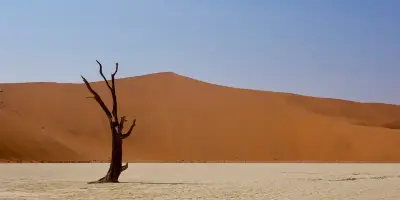
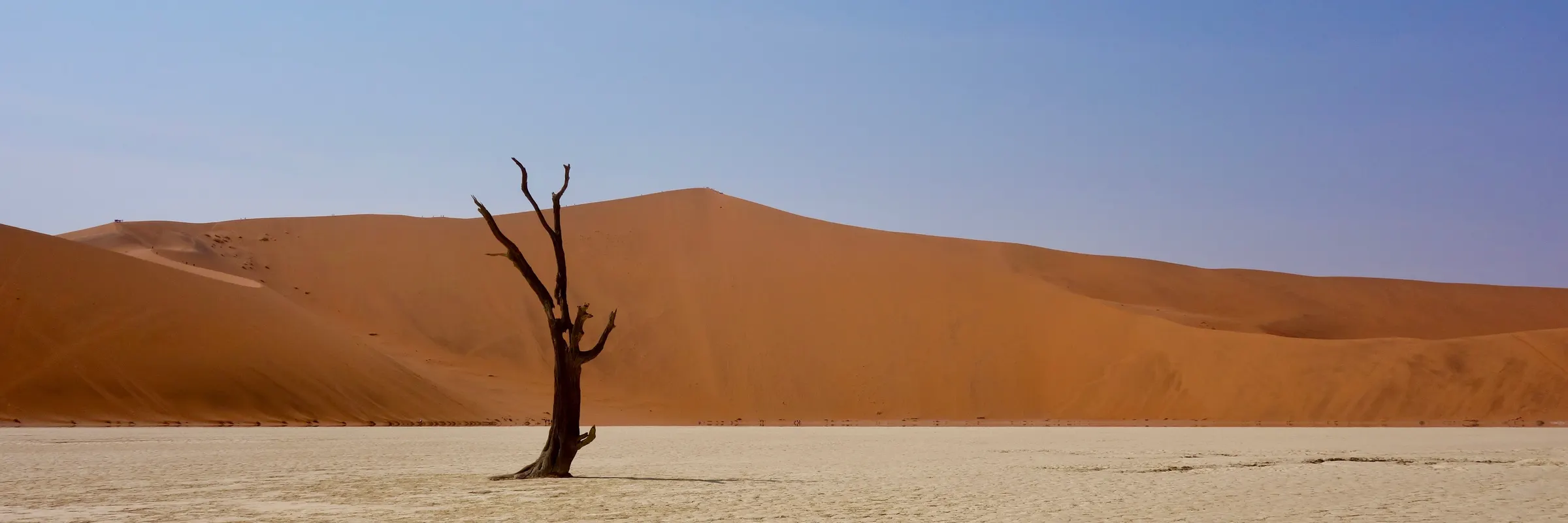
Sossusvlei: a dead camel thorn on the clay pan at Deadvlei
Photo: Sonse · CC BY 2.0
Namib-Naukluft, Namibia

Sossusvlei: how many days you need and the best months to go

Sossusvlei is not a town. It is a salt and clay pan at the end of the Tsauchab, a river that has not reached the sea in a very long time, inside the Namib-Naukluft park in Namibia. The Namib is generally considered the oldest desert in the world, and the dunes around the pan are among the highest anywhere — deep orange-red from iron oxide, and shaped so that the light on them changes completely in the space of an hour. Two days is the working figure, and where you sleep matters more here than in any other destination on this site.

Short answers

What people ask before booking

How many days do you need in Sossusvlei?

Sossusvlei needs two days, shaped by the light: one dawn at the dunes and one at Deadvlei. Sleeping inside the park gate buys you an hour the outside gate does not.

What is the best month to visit Sossusvlei?

May, June, July and August — The cool dry season, and the reason to come. September — Still clear, warming up, and slightly quieter.

Which months are worth avoiding in Sossusvlei?

December and January — The hottest weeks, and climbing becomes unsafe. February and March — The rainy season, such as it is.

How many days Sossusvlei needs

Two days is right, and the shape of them is fixed by the light. One dawn at the dunes and one at Deadvlei is the trip; the middle of the day is too hot and too flat to photograph, and the afternoon belongs to Sesriem Canyon or to sitting still.

A third day is worth having if you want to walk properly rather than climb one dune and leave, or if you are going on to the Naukluft mountains. Almost nobody needs four. This is a destination you visit inside a longer Namibian route rather than one you base yourself in.

Inside the gate or outside it, which is the whole decision

The park has an outer gate at Sesriem and an inner one, and the outer gate opens at sunrise while the inner one opens an hour earlier for guests staying inside. That hour is the entire difference between arriving at the dunes with the first light on them and arriving to find that the light has already gone flat.

The consequence is straightforward and expensive. Lodges inside the gate cost considerably more than the ones on the road outside, and in high season they book out months ahead. If the photographs are the reason for the trip, sleep inside. If they are not, staying outside is perfectly reasonable — you will simply be at the dunes an hour later than the people who did, along with everyone else.

The dunes, and which one to climb

The dunes here are numbered by their distance in kilometres along the road from the gate, which is why they have names like Dune 45. They are star dunes, formed by wind coming from several directions, and they hold their shape over long periods rather than migrating.

Climb one, not three. The sand is soft, the slope is steeper than it looks and going up a big dune in the heat is genuinely hard work. Pick according to what you want: the one everyone photographs at sunrise, the one that is a serious climb, or the short one behind the pan.

  • Dune 45 — forty-five kilometres from the gate, roadside, and the classic sunrise climb. About twenty minutes up.
  • Big Daddy — over three hundred metres and the big one, an hour or more of climbing, with a run down the face into Deadvlei at the end.
  • Deadvlei — the white clay pan with the dead trees, reached on foot over a low dune from the car park. The reason most people come.
  • Sesriem Canyon — a narrow gorge cut by the same river, an easy afternoon walk and shaded, which nothing else here is.
  • Elim Dune — near the gate and climbable in the last hour of light without driving anywhere.

Deadvlei, and what you are actually looking at

Deadvlei is a white clay pan with a stand of black dead camel thorn trees standing on it, backed by an orange dune. It is one of the most photographed landscapes in Africa and it looks unreal in person as well.

The trees are the point. They died roughly six to seven hundred years ago, when shifting dunes cut the river off from the pan, and they have not rotted because it is far too dry for the fungi and bacteria that would decompose them. They are scorched black by the sun rather than burnt. What you are standing among is a forest that has been dead since before Columbus sailed and is still standing up.

Practicalities, and the ones that actually matter

This is a place where the logistics are the trip. The last five kilometres to the pan are deep sand and need a proper 4x4 — a soft-roader will bog down, and a shuttle runs from the two-wheel-drive car park for those who do not have one. Do not attempt it in a saloon.

The rest is heat and distance. There is no shade anywhere on the dunes, no water for sale beyond the gate, and the nearest fuel is at Sesriem. Take far more water than you think you need, climb in the first two hours of light or the last two, and check the gate times for the season, because they move with sunrise. Fuel up whenever you pass a pump; the distances between them in Namibia are long.

What is around it

Sossusvlei is almost always part of a longer route, and the things near it are worth knowing before you plan. Solitaire, a settlement of about a hundred people on the road north, is famous for apple pie — genuinely, it is the landmark everyone stops at, and it is the only fuel and food for a long way.

Further out, the Naukluft mountains rise directly behind the dunes and hold hiking trails, and Swakopmund on the coast is four to five hours northwest, where the desert meets the Atlantic and the temperature drops twenty degrees. South of here the road runs to the Fish River Canyon. None of these are day trips; they are the next stop.

What to eat around Sossusvlei, and where

There is no town here and no restaurant scene: you eat at your lodge, and what arrives is southern African cooking done over fire. Namibia is a meat country with a strong German influence, and the two show up on every menu in the region.

  • Potjiekos

    What to order

    The pot the lodge cooks in

    A stew cooked slowly in a three-legged cast-iron pot set over coals, layered rather than stirred so the ingredients keep their shape. It is the standard way of feeding a group outdoors across southern Africa and it is what most lodges here will serve you at least once. Ordered by the pot, not the plate.

    Check it on Wikidata
  • Braai

    What to order

    The fire, and what it means socially

    The southern African barbecue — wood rather than charcoal, cooked slowly, and a social occasion rather than a cooking method. It is a genuine institution in Namibia and South Africa, and at a lodge in the desert it is the evening. Expect several kinds of meat and very little else.

    Check it on Wikidata
  • Gemsbok

    What to order

    The antelope you will be offered

    A large desert antelope with straight horns, native to this region and on the Namibian coat of arms. It is farmed and culled rather than poached, and it is genuinely the local meat here — lean, dark and better rare. If you eat one game meat in Namibia, make it this.

    Check it on Wikidata
  • Biltong

    What to order

    What to have in the car

    Meat salted, spiced with coriander and vinegar and air-dried, cut thick. It predates refrigeration in southern Africa and is not the same as American jerky — softer, less sweet, and sold by weight at every filling station. The distances here make it the right thing to have on the passenger seat.

    Check it on Wikidata
  • Kapana

    What to order

    The grill you pass on the way

    Beef grilled over open fires at roadside and market stands, cut into pieces and eaten with a spiced salt dip, standing up. It is Namibia's own street food and it is a town thing — Windhoek and Swakopmund rather than the desert. Worth stopping for on the drive in or out.

    Check it on Wikidata

When to go, and what each month costs you

The Namib is hyper-arid and the visit is decided by temperature rather than rain. The cool dry months from May to September are the window; December and January are punishingly hot, and the little rain there is falls in the southern summer.

  • May, June, July and August

    Go now

    The cool dry season, and the reason to come

    Warm days, cold nights — genuinely near freezing before dawn — and clear, still air with the best light of the year on the dunes. This is peak season and the inside-the-gate lodges book out months ahead. Take a proper jacket for the sunrise; people consistently underestimate this.

  • September

    Go now

    Still clear, warming up, and slightly quieter

    The nights lose their edge and the days warm up without becoming unbearable, and the peak-season crowd starts to thin. The best compromise month if you cannot get an inside booking for July. Clear skies and excellent stargazing.

  • April

    Worth it, but

    The rain finished, and the desert briefly green

    The last of the summer rain has passed and in a wet year there is grass on the plains and the pans hold water, which is unusual and worth seeing. Warm days and mild nights. Prices are below the winter peak.

  • October

    Worth it, but

    Hot and getting hotter, but still clear

    Daytime heat builds sharply through the month while the skies stay clear and the crowds fall away. Dawn and dusk are still excellent; the middle of the day is not. Reasonable value if you plan around the hours.

  • November

    Worth it, but

    Very hot, occasional storms, and cheap

    The first rains may arrive as short violent afternoon storms, which are spectacular over the dunes. Temperatures are high enough to make climbing unwise after mid-morning. Low prices and few people.

  • December and January

    Think twice

    The hottest weeks, and climbing becomes unsafe

    Peak summer heat in a place with no shade, no water and deep sand. Climbing a dune in the middle of a December day is genuinely dangerous rather than merely uncomfortable. Christmas and New Year push prices up regardless, which makes this the worst trade on the calendar.

  • February and March

    Think twice

    The rainy season, such as it is

    The wettest weeks of a very dry year, with heat, humidity by desert standards and the chance of flash flooding that closes roads. Some lodges close. In a good rain year the desert flowers and the pans fill, which is genuinely remarkable — and it is a gamble on a few days out of a decade.

Things that change the trip

  • Sleep inside the park gate if the photographs matter. Inner-gate guests get in an hour earlier, and that hour is the whole difference at sunrise.
  • Take a proper jacket. Winter nights in the desert are close to freezing before dawn, and everyone is surprised by it.
  • You need a real 4x4 for the last five kilometres, or the shuttle from the two-wheel-drive car park. Deep sand does not negotiate.
  • Climb one dune, not three. The sand is soft, the slope is steeper than it looks, and the heat makes the second one a mistake.
  • Carry far more water than seems reasonable. There is no shade and nothing for sale past the gate.
  • Stop at Solitaire for the apple pie. It is a hundred-person settlement with a bakery, and it is the only fuel and food for a very long way.

Plan Sossusvlei inside a Namibian route

A trip that links Sossusvlei with Swakopmund, Damaraland, Etosha or the Fish River Canyon, with the driving distances and the gate times arranged properly, is exactly what Premium is for. The free version covers one destination of up to three days.

Destinations