


Skip to content
JoruJoru
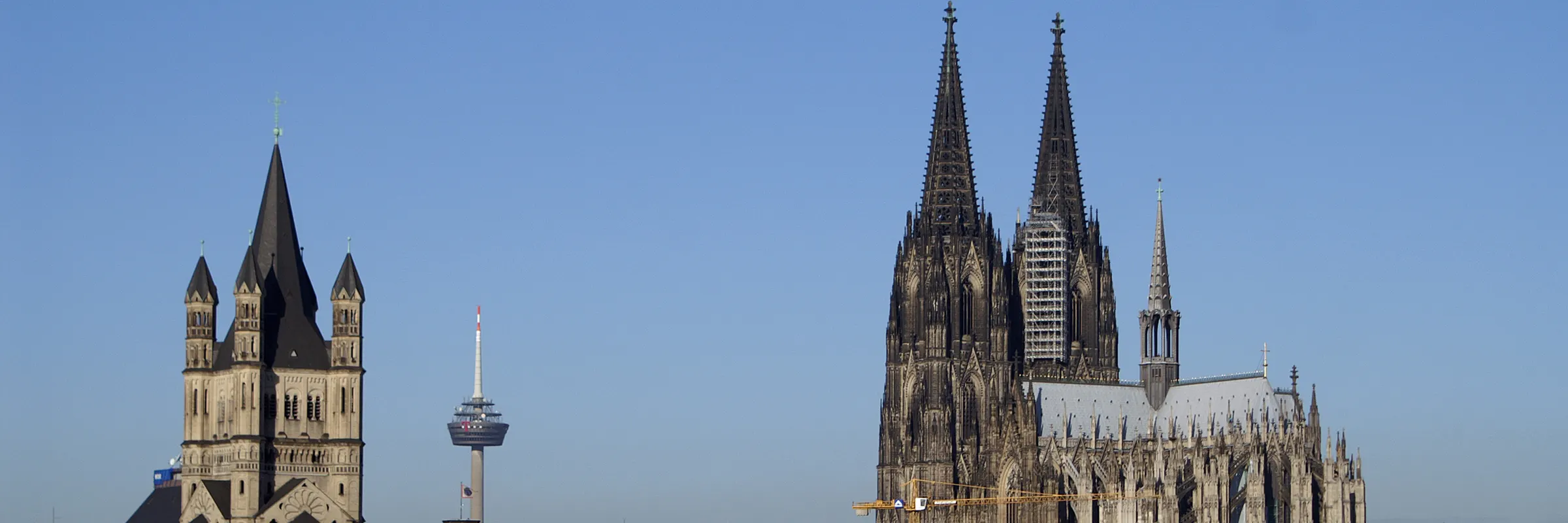
Cologne: Great St. Martin and the cathedral, seen from across the Rhine

North Rhine-Westphalia, Germany

Cologne: how many days you need and the best months to go

Photo: Rolf Heinrich (Köln) · CC BY 3.0

Cologne was founded by the Romans on the Rhine and has been one of the great cities of Germany ever since. Its cathedral, begun in the thirteenth century and finished in the nineteenth, is the largest Gothic church in northern Europe and rises right beside the main station, the first thing every traveller sees. Around it, the city was flattened in the Second World War and rebuilt plainly, but it kept twelve great Romanesque churches, Roman remains under its streets, excellent museums of art and chocolate, and above all its character: a sociable, ironic, Catholic Rhineland city that drinks its own beer, Kölsch, in tall thin glasses in noisy brewery halls, and turns itself upside down every year for Carnival. The planning problem is the calendar. Carnival week, the trade fairs at its huge exhibition centre and the Christmas markets fill the hotels and send their prices soaring; outside them, Cologne is an easy and friendly stop of a day or two, and a base for Bonn, Aachen and the Rhine valley.

Short answers

What people ask before booking

How many days do you need in Cologne?

Cologne needs one full day for the cathedral and its tower, the old town by the Rhine, a museum and an evening in a brewery hall. A second day adds the Romanesque churches, the Belgian quarter, the old harbour or a trip to Bonn or the Rhine valley. Check the dates of Carnival and the trade fairs before you book.

What is the best month to visit Cologne?

May to September — The Rhine and the beer gardens.

Work out how many hours you will have in Cologne on your dates
When to go, and what each month costs you

Cologne has a mild climate: warm summers, mild, grey winters, and rain spread through the year. Summer is the best season for the river and the beer gardens; the Carnival and the Christmas markets are the two great events of the cold months.

  1. January: Worth it, but
  2. February: Worth it, but
  3. March: Worth it, but
  4. April: Worth it, but
  5. May: Go now
  6. June: Go now
  7. July: Go now
  8. August: Go now
  9. September: Go now
  10. October: Worth it, but
  11. November: Worth it, but
  12. December: Worth it, but
  • May to September

    Go now

    The Rhine and the beer gardens

    Warm days, long evenings by the Rhine and the beer gardens open. The large summer trade fairs, and the gay pride parade in summer, fill the hotels for their weeks; check the dates.

  • October and November

    Worth it, but

    Grey, and the Carnival season opens

    Cool, often grey and wet days. The Carnival season opens on the eleventh of November at 11:11, with crowds in costume in the old town for a day.

  • December

    Worth it, but

    Christmas markets

    Cold, dark days lit by half a dozen Christmas markets, the best known beneath the cathedral. Hotels fill on the weekends of Advent.

  • January to April

    Worth it, but

    Grey, and the street Carnival

    Cold, grey days and rain. The street Carnival takes over the city for the six days before Ash Wednesday, whose date moves with Easter, between February and March, with the great parade on Rose Monday; it is unforgettable, packed and expensive. Spring comes in April.

What to pack for Cologne, month by month

How many days Cologne needs

One full day covers the essentials: the cathedral and the climb up its tower, the old town between the cathedral and the Rhine, a museum — modern art, Roman Cologne or chocolate — a walk across the railway bridge for the view, and an evening in a brewery hall.

A second day adds the rest: the Romanesque churches, the Belgian quarter and Ehrenfeld for shops and bars, the old harbour with its crane-shaped buildings, a boat on the Rhine, or a day trip to Bonn, Aachen's cathedral or the castles of the Rhine gorge further south.

How the city is arranged, along the Rhine

The old city lies in a half circle on the left bank of the Rhine, inside the ring road that replaced its medieval walls, with the cathedral and the main station at its northern end. Across the river, Deutz has the exhibition centre and the best view of the cathedral; the lively districts of the west and south lie just outside the ring.

  • The cathedral and the old town — the cathedral square, the museums around it and the old town's lanes and squares down to the Rhine.
  • The shopping streets — the long pedestrian streets running south and west of the cathedral.
  • The Belgian quarter and Ehrenfeld — the western districts of independent shops, cafés, bars and clubs.
  • The Südstadt and the Rheinauhafen — the south, with local pubs and the old harbour's modern buildings on the river.
  • Deutz — the right bank, with the exhibition centre, the riverside park and the view across to the cathedral.

Where to stay, and what each area costs you

The area around the cathedral and the station is the practical base, with everything on foot; the Belgian quarter suits nightlife, and Deutz is convenient for the fairs and the view.

Before booking, check the dates of Carnival and the trade fairs: during them, hotels fill and prices rise steeply. The Christmas markets of Advent also fill the weekends. The city charges a tax on overnight stays.

AreaWho it suitsThe catch
Around the cathedral and the stationShort stays: the cathedral, the museums, the old town and the trains on foot.Busy and touristy, and loud on weekend nights.
The old town by the RhineThe brewery halls, the river promenade and the old squares on the doorstep.Rowdy at night and at weekends, especially at Carnival.
The Belgian quarterIndependent shops, cafés and the best bars, a few stops from the cathedral.Noisy at night, and few large hotels.
DeutzThe exhibition centre, the riverside and the classic view of the cathedral across the Rhine.Across the river from the old town, and full during the fairs.

Compare these areas against your priorities

Getting there, and getting around

Cologne's main station is next to the cathedral, and one of the great railway hubs of Europe: fast trains reach Frankfurt in about an hour, Brussels in under two, Amsterdam in under three and Paris in a little over three. The Cologne-Bonn airport is a short train ride away, and Düsseldorf's within an hour.

The centre is compact and walkable. Trams and the underground, often the same lines, cover the rest of the city.

  • Germany's national monthly travel pass covers all local transport.
  • At Carnival, the old town is packed and costumed; trains and trams run extra services but fill completely.
  • Climb the cathedral's south tower for the view; it is more than five hundred steps, with no lift.
  • The railway bridge behind the cathedral has a footpath across the Rhine, lined with lovers' padlocks.

The cathedral, the Romanesque churches and the museums

Cologne Cathedral is the city's reason for being visited: twin spires over a hundred and fifty metres high, a forest of Gothic pillars, medieval stained glass and, behind the high altar, a golden shrine said to hold relics of the Three Kings, which made the city one of the great pilgrimage centres of the Middle Ages. Building began in 1248 and stopped for centuries; the spires were finished only in 1880. It is a World Heritage Site.

  • The Romanesque churches — twelve great medieval churches, rebuilt after the war, around the old town.
  • Museum Ludwig — one of the great collections of modern art in Europe, next to the cathedral.
  • The Chocolate Museum — the history of chocolate, with a working production line, by the river.
  • The Wallraf-Richartz Museum — medieval painting of the Cologne school and the European masters.
  • The Rheinauhafen — the old harbour, with three modern buildings shaped like upside-down harbour cranes.
  • The view from Deutz — the cathedral and the old town from across the Rhine, best at dusk.

How eating works here

Cologne eats in its brewery halls: the local beer in small glasses, a rye roll with cheese that is jokingly called «half a chicken», black pudding with mashed potatoes and apples, crisp potato pancakes and pot roast. The waiters, called Köbes, are famously brusque, and part of the show.

Lunch from noon and dinner from six or seven. In the brewery halls, the beer keeps coming: the waiter replaces each empty glass with a full one, and marks a line on your beer mat, until you put the mat on top of the glass.

  • Kölsch is served only in small thin glasses, so it is always fresh.
  • Put your beer mat on your glass when you want no more.
  • Tipping: round up or add about a tenth, telling the waiter the total when you pay.
  • At Carnival, street food and beer are sold everywhere, day and night.

Where to eat in Cologne, and what to order

Cologne eats and drinks in its brewery halls: the local beer in small glasses, a rye roll with cheese called «half a chicken», black pudding with mash and apples, and crisp potato pancakes. Go to a traditional brewery near the cathedral, and let the waiter bring the beer.

  • Kölsch

    What to order

    The local beer, in small glasses

    A light, crisp, top-fermented beer that may only be called by its name if it is brewed in and around the city. It is served in tall, thin glasses of a fifth of a litre, replaced by the waiter as soon as they are empty.

    Check it on Wikidata
  • Früh am Dom

    Institution

    A traditional brewery hall

    One of the old brewery halls near the cathedral, with dark wood, long tables, blue-aproned waiters and its own beer from the barrel. It is the place to eat the Rhineland dishes, among locals and visitors at shared tables.

    Check it on Wikidata
  • Halver Hahn

    What to order

    «Half a chicken», which is not a chicken

    A rye roll with a thick slice of aged Dutch cheese, mustard and onions. Its name, «half a chicken», is a Cologne joke that every visitor falls for once; it is the classic snack with a beer.

    Check it on Wikidata
  • Himmel un Ääd

    What to order

    Heaven and earth

    Fried black pudding with mashed potatoes and stewed apples, with fried onions on top. The name comes from the apples, from the trees, and the potatoes, from the earth; a classic of the brewery halls.

    Check it on Wikidata
  • Rievkooche

    What to order

    Crisp potato pancakes

    Grated potato fried into thin, crisp pancakes, served with apple sauce, or with black bread and sugar beet syrup. They are sold at the Christmas markets and in the brewery halls, best hot from the pan.

    Check it on Wikidata

Things that change the trip

  1. Check the Carnival and trade-fair dates before booking.
  2. Climb the cathedral's tower early, before the queue.
  3. Drink Kölsch in a brewery hall, and put your beer mat on the glass when you have had enough.
  4. Cross the railway bridge to Deutz for the view of the cathedral at dusk.
  5. Order «half a chicken» to see what arrives.
  6. Use Cologne as a base for Bonn, Aachen and the Rhine valley.

Plan Cologne with the Rhine

A trip of more than three days, or one that joins Cologne with Bonn, the Rhine valley, Amsterdam, Brussels or Berlin and the trains between them, is what Premium is for. The free version covers one destination of up to three days.

Destinations