
Skip to content
JoruJoru
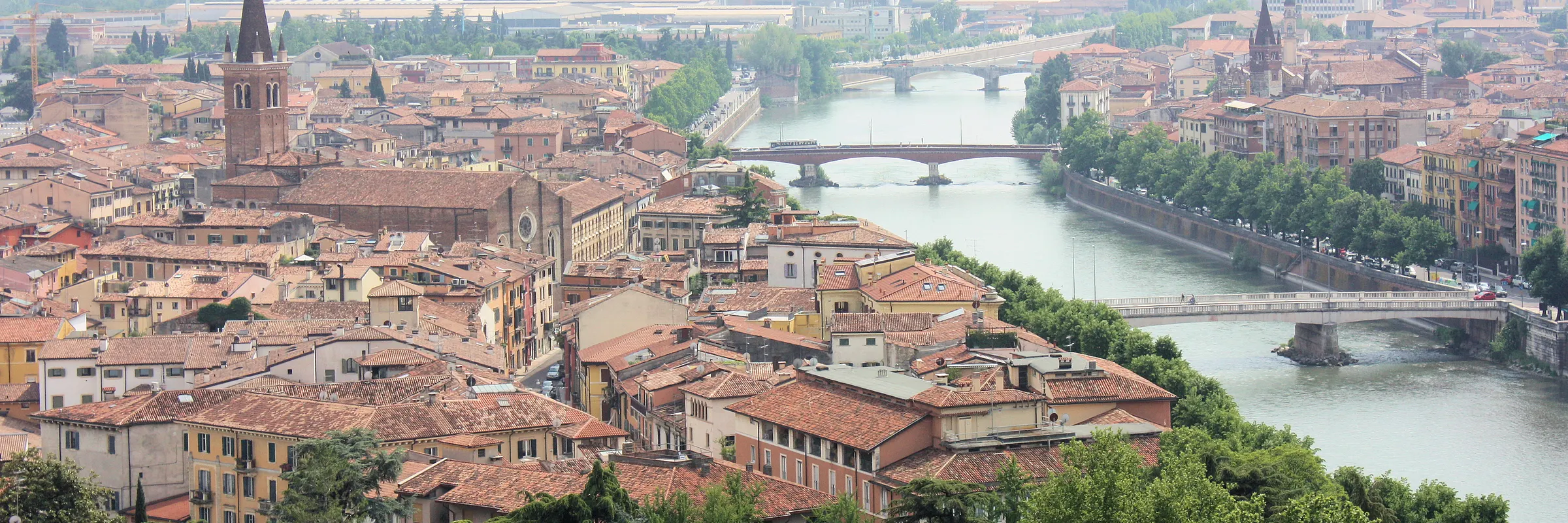
Verona: The Adige and the rooftops of Verona from Castel San Pietro

Veneto, Italy

Verona: how many days you need and the best months to go

Photo: Dguendel · CC BY 3.0

Verona is one of the most beautiful small cities in Italy, and one of the most visited for a single afternoon. Its old town sits inside a tight loop of the river Adige: a Roman amphitheatre still in use, squares paved in pink marble, the tombs and towers of the medieval lords who ruled it, and a Romanesque basilica that is among the finest in the north. Shakespeare set Romeo and Juliet here, and a medieval house with a balcony added in the twentieth century draws crowds to a small courtyard every day. Around the city lie the vineyards of Valpolicella and Soave, and Lake Garda is half an hour away. The planning problem is its two calendars. By day, tour groups from Venice and the lake fill the centre; in summer, the opera festival in the Arena fills the hotels on performance nights. Sleep in Verona, and see it in the morning and in the evening, when it belongs to the Veronese.

Short answers

What people ask before booking

How many days do you need in Verona?

Verona needs one full day for the Arena, the squares, the view from Castel San Pietro and the basilica of San Zeno, and a night for the opera in summer. A second day is for Castelvecchio, the wine country of the Valpolicella or Lake Garda, half an hour away.

What is the best month to visit Verona?

April to June — Spring, and the start of the opera. September and October — The harvest, and the last operas.

Work out how many hours you will have in Verona on your dates
When to go, and what each month costs you

Verona has the climate of the Po plain softened by the Alps and the lake: hot, humid summers, cold and sometimes foggy winters, and pleasant springs and autumns. The opera season sets the summer, and the wine fair the spring.

  1. January: Worth it, but
  2. February: Worth it, but
  3. March: Worth it, but
  4. April: Go now
  5. May: Go now
  6. June: Go now
  7. July: Worth it, but
  8. August: Worth it, but
  9. September: Go now
  10. October: Go now
  11. November: Worth it, but
  12. December: Worth it, but
  • April to June

    Go now

    Spring, and the start of the opera

    Mild to warm days and the gardens in flower, with the opera festival opening in June. The city's great wine fair, in spring, fills every hotel for several days; check its dates before booking.

  • September and October

    Go now

    The harvest, and the last operas

    Warm days that cool through October, the grape harvest in the Valpolicella and Soave, and the last performances in the Arena in early September. The best time for the vineyards and the lake.

  • July and August

    Worth it, but

    Hot, busy and the opera season

    Hot, humid days and warm nights, the centre full of day-trippers and the Arena full every performance night. Visit early and late, and rest in the afternoon; book rooms and opera seats well ahead.

  • November to March

    Worth it, but

    Fog, cold and Christmas

    Cold, damp days, sometimes foggy, and the city at its quietest and cheapest. Christmas brings markets and the pandoro; the Arena is closed to opera, but open to visit.

What to pack for Verona, month by month

How many days Verona needs

One full day covers the old town: the Arena, Piazza delle Erbe and Piazza dei Signori, the view from the Lamberti tower, the Roman bridge and the hill across the river, and the basilica of San Zeno at the western end. In summer, an evening at the opera in the Arena makes the night.

A second day is for the region or a slower pace: the castle museum of Castelvecchio and the Giusti garden, a wine tour in the Valpolicella, the walled town of Soave, or Lake Garda, half an hour away.

How the city is arranged, in a loop of the river

The Adige makes an S through Verona. The old town fills the first loop, with the Arena on its southern edge and the medieval squares at its heart; across the river to the east, the hill of San Pietro rises above the Roman theatre. The railway station, Porta Nuova, is a fifteen-minute walk south of the Arena, outside the walls.

  • Piazza Bra and the Arena — the great square at the gate of the old town, with the amphitheatre and the cafés facing it.
  • Piazza delle Erbe and Piazza dei Signori — the old Roman forum, now a market square, and the square of the lords, with the Lamberti tower above.
  • Via Mazzini and the old town — the marble shopping street and the lanes around Juliet's house.
  • Veronetta and the hill — across the river: the Roman theatre, the university, and the hill of Castel San Pietro with the view of the city.
  • San Zeno — the western quarter around the Romanesque basilica, quieter and more local, near Castelvecchio.

Where to stay, and what each area costs you

Staying inside the old town lets you see it before and after the day-trippers, and walk home from the opera. Veronetta and San Zeno are cheaper and more local, a short walk away.

Prices peak on opera nights from June to September and during the great wine fair in spring, which fills every bed in the city and around it for several days. The city charges a tourist tax per person and per night.

AreaWho it suitsThe catch
The old townThe sights, the squares and the Arena on foot, and the evenings when the crowds have gone.The dearest rooms, crowded by day, and full on opera nights.
VeronettaAcross the river: student bars, local trattorias and lower prices, under the hill with the view.Less polished, and uphill in parts.
San ZenoA quiet, local quarter around the basilica, with good trattorias.A fifteen- to twenty-minute walk from the centre.
Near Porta Nuova stationTrains, the airport bus and cheaper hotels.Outside the walls, with little charm, a quarter of an hour from the Arena.

Compare these areas against your priorities

Getting there, and getting around

Verona is a railway crossroads: trains reach Venice in a little over an hour, Milan in about an hour and a quarter and Bologna in under an hour, and run north through the Alps to Austria and Germany. The small airport is linked to the station by bus.

The old town is for walking, and much of it is closed to traffic. Buses run from the station to the centre and to San Zeno; the hill of San Pietro has a short funicular.

  • Do not drive into the old town: it is a restricted traffic zone with cameras.
  • A city card covers the main monuments and the buses for a day or two; it pays off if you visit several.
  • Lake Garda is a short train ride to Peschiera or a bus ride to Sirmione and Garda.
  • For the opera, book weeks ahead in high summer; the cheapest seats are on the stone steps, unnumbered, so bring a cushion.

The Arena, the squares and San Zeno

The Arena is a Roman amphitheatre of the first century, one of the best preserved in the world, and since 1913 the stage of an opera festival every summer: grand productions of Verdi and Puccini for an audience of thousands under the open sky, with candles lit on the steps. Visit it by day, and if your dates allow, come back for a performance at night.

  • Piazza delle Erbe — the old Roman forum, ringed by painted palaces, with its market and the Lamberti tower above it.
  • The Scaliger tombs — the Gothic tombs of the medieval lords of Verona, behind their iron railings next to Piazza dei Signori.
  • San Zeno Maggiore — one of the great Romanesque churches of Italy, with bronze doors and an altarpiece by Mantegna.
  • Castelvecchio — the castle of the Scaligers, now a museum of medieval and Renaissance art, with its fortified bridge over the Adige.
  • Castel San Pietro — the hill across the Roman bridge, with the best view of the city's roofs and bends of the river.
  • Juliet's house — a medieval house with a balcony added in the twentieth century; the courtyard is crowded, the story is fiction, and the city loves it anyway.

How eating works here

Verona's food is that of the Veneto inland: rice more than pasta, risotto made with the local red wine, thick fresh pasta, slow stews and boiled meats with a peppery bread sauce that is the city's own. It is also a wine capital, with the reds of the Valpolicella and the whites of Soave on every list.

Italian hours apply: lunch from half past twelve, dinner from half past seven. Before the opera, restaurants serve early; after it, many stay open late for the audience.

  • Osterie, the old wine bars, serve local wine by the glass with small plates.
  • Horse and donkey meat appear on traditional menus, in stews and pasta sauces; ask if you would rather avoid them.
  • The pandoro, the tall star-shaped Christmas cake, was born in Verona.
  • A cover charge is often added per person; tipping beyond it is optional.

Where to eat in Verona, and what to order

Verona is a wine city first: the great dried-grape red of the Valpolicella and the white of Soave, a thick hand-made pasta with rich sauces, and the golden Christmas cake the city invented. Eat in an osteria, and drink by the glass.

  • Amarone della Valpolicella

    What to order

    The great red of the Valpolicella

    A rich, dry red made from grapes dried for months after the harvest, which concentrates their sugar and flavour. It is the great wine of the hills north-west of the city, and the risotto made with it is a Veronese classic; order a glass rather than a bottle if you only want to taste it.

    Check it on Wikidata
  • Soave

    What to order

    The white wine of Soave

    A dry, fresh white wine from the hills around the walled town of Soave, east of the city, made mostly from the Garganega grape. It is the white of every Veronese table, and goes with risotto, fish from the lake and the cured meats of the aperitivo.

    Check it on Wikidata
  • Bigoli

    What to order

    The thick hand-made pasta

    Long, thick strands of pasta pressed through a bronze die, rough enough to hold a heavy sauce. In Verona they come with sardines or with a slow ragù, traditionally of donkey meat; it is the pasta of the trattorias of the city and the hills.

    Check it on Wikidata
  • Pandoro

    What to order

    The golden cake of Christmas

    A tall, star-shaped cake of rich yeast dough, dusted with icing sugar, soft and buttery. It was created in Verona in the late nineteenth century and is now eaten all over Italy at Christmas; the pastry shops of the city still bake their own.

    Check it on Wikidata

Things that change the trip

  1. Sleep in Verona and see the centre early and late, without the day-trippers.
  2. Check the dates of the spring wine fair before you book.
  3. Go to the opera in the Arena if your dates fall in the season, and book ahead.
  4. Climb to Castel San Pietro, by the steps or the funicular, for the view at sunset.
  5. Walk to San Zeno, which most visitors never reach.
  6. Take a day for the Valpolicella or Lake Garda.

Plan Verona with the lake and Venice

A trip of more than three days, or one that joins Verona with Lake Garda, Venice, Milan or the Dolomites and the trains between them, is what Premium is for. The free version covers one destination of up to three days.

Destinations