Skip to content
JoruJoru
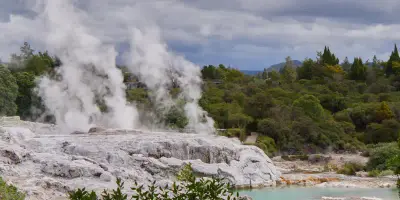
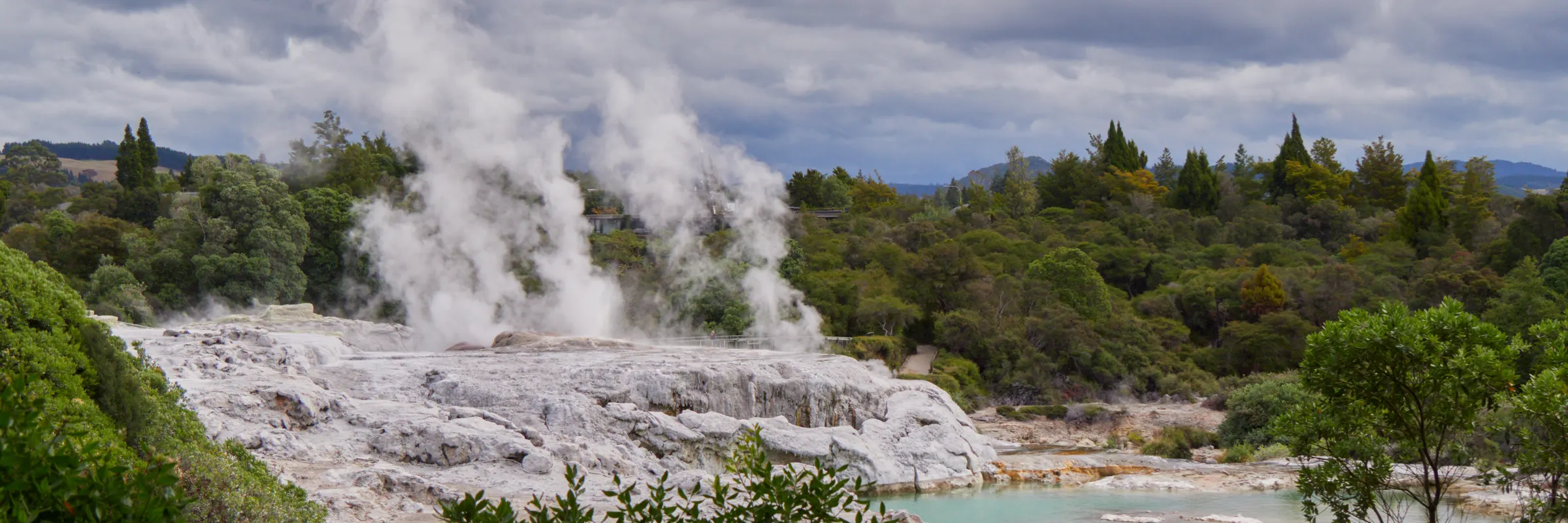
Rotorua: the geothermal terraces at Whakarewarewa
Photo: lumoplank · CC0
Bay of Plenty, New Zealand

Rotorua: how many days you need and the best months to go

Rotorua sits inside a caldera on the most active stretch of the Taupō Volcanic Zone, which means geysers, boiling mud and silica terraces are not an excursion here — they are in the municipal park and the front gardens. It is also the heart of Te Arawa territory and has been receiving visitors since the nineteenth century, longer than almost anywhere else in the country. Two days covers the geothermal and the cultural side. A third is for the forest, the lakes or the trout.

Short answers

What people ask before booking

How many days do you need in Rotorua?

Rotorua needs two days — one for a geothermal park and the living Māori village, one for a thermal area outside town and a marae evening — and a third for the forest or the lakes.

What is the best month to visit Rotorua?

November and December — Late spring, before the country goes on holiday. February, March and April — The most settled weather of the year.

Which months are worth avoiding in Rotorua?

June, July, August and September — Winter and early spring — wet, cold and dark early.

How many days Rotorua needs

Two days is the working figure. One goes to a geothermal park and the living Māori village in town; the other goes to a second thermal area outside the city and an evening on a marae, which is the part most people remember. That is a complete visit and it is what most itineraries allow.

A third day changes the trip rather than extending it. It goes to the redwood forest and its mountain-bike network, to the lakes, or to the valley that a volcanic eruption created in 1886 — and any of those is a full half-day at minimum. Beyond three days you are choosing Rotorua as a base for the central North Island, which is a reasonable thing to do.

Why the town smells, and what that means

The smell is hydrogen sulphide, it comes from the ground, and it is everywhere: in the park, along the lakefront, in the drains and in some hotel rooms. Almost everyone stops noticing it within a day, and the ones who do not tend to be the ones who were told not to expect it. It is not a sign of anything wrong.

It has two practical consequences worth knowing before you arrive. Silver tarnishes here — jewellery left out for a few days will darken, and that is the sulphur, not the housekeeping. And the same ground that produces the smell produces thin crust: the marked paths in thermal areas are marked because the ground beside them is not reliably solid, and people have been seriously burned stepping off them for a photograph.

Which geothermal area to choose

This is the actual planning problem. There are half a dozen thermal parks within forty minutes and they are not interchangeable — each one leads with a different feature, and doing three of them in two days produces diminishing returns fast. Pick one in town and one outside it.

The one in town is the valley at Whakarewarewa, which two separate operations enter from opposite sides: the living village, where people still cook in the steam boxes and bathe in the pools, and the arts institute, where the national carving and weaving schools are. Both look onto Pōhutu, the largest active geyser in the southern hemisphere, which plays several times a day.

  • The living village — a working settlement, not a reconstruction: houses, a school, cooking pools and guides from the families who live there. The most human of the options.
  • The arts institute — the same thermal valley from the other side, plus the national schools of carving and weaving and a kiwi house. The better choice if you want to see the crafts being taught.
  • Wai-O-Tapu — the colours: a champagne-coloured pool ringed in orange, green lakes and collapsed craters. The most photographed and the most crowded. Its geyser is triggered with soap at a set time each morning, which is worth knowing before you build a schedule around it.
  • Waimangu — the valley created by the 1886 eruption, and therefore the youngest geothermal system on earth. Quieter, greener, and walked downhill through a river valley rather than around a loop.
  • Hell's Gate — the most violent of them: boiling mud on a large scale, a sulphur waterfall, and mud baths you can get into.

The 1886 eruption, and what it destroyed

Before 1886, the reason to travel to this part of the world was the Pink and White Terraces: vast staircases of silica on the shore of Lake Rotomahana, the largest formations of their kind on record, described in the tourism of the day as the eighth wonder of the world. Te Arawa guides had been taking visitors out to them by canoe for decades, which is where Rotorua's tourism industry actually begins.

On the night of 10 June 1886 Mount Tarawera split open along a fissure kilometres long, buried the surrounding villages and blew the terraces and the lake apart. The eruption killed more than a hundred people, most of them Māori, and destroyed the village of Te Wairoa, which was excavated later and can be visited. Waimangu is the valley the same eruption opened, which is why nothing in it is older than that night.

The Māori side, and how to approach it

Rotorua has one of the highest proportions of Māori population of any city in New Zealand, and the cultural experiences here are run by the iwi whose land it is rather than sold on their behalf. The standard evening is a pōwhiri — a formal welcome — followed by a performance and a hāngī meal, and it is worth understanding what the first part is before you are standing in it.

A pōwhiri opens with a challenge: a warrior approaches, makes a display and lays down a token, which a chosen person from the visiting group picks up to show they come in peace. This is protocol, not theatre, and the group is expected to behave as a group — you will be asked to choose a speaker and, usually, to sing something together. The good operations explain all of this beforehand.

  • Do not step in front of the challenger or laugh during the wero. It is a formal exchange with a specific meaning.
  • Pick your representative before you arrive if you can. Every group has to and every group is caught out.
  • Take off your shoes before entering the wharenui, and do not eat or sit on tables anywhere on a marae.
  • Ohinemutu is free and open. The lakeside village in town has a church with a window showing Christ in a Māori cloak, apparently walking on the lake behind it.

Getting here, and getting around

Rotorua is about three hours by road from Auckland and an hour from Taupō, and it is realistically a driving destination: the thermal parks are spread over forty kilometres of countryside, the buses between them are thin, and a rental car is what the trip is designed around.

In the town itself the distances are short. The lakefront, the gardens, the living village and the restaurant street are all within a walk of each other, and the forest is a few minutes out. If you are not driving, base yourself in the centre and treat the outlying parks as tours rather than as day trips you make yourself.

  • The redwood forest is free to walk and to ride. It was planted from 1901 as a timber experiment and now holds one of the best mountain-bike networks anywhere.
  • You cannot buy wild trout in New Zealand. Selling it is illegal, so the only way to eat the fish these lakes are famous for is to catch it — some places will cook your own catch for you.
  • A fishing licence is required and is checked, and the season on some of the lakes is restricted. Buy it before you go out, not after.
  • The old bath house in the Government Gardens has been through a long seismic strengthening. Check its status before planning a morning around the museum inside it.

What to eat in Rotorua, and where

This is the one place in New Zealand where the food is genuinely local rather than generically good, because the ground does the cooking. Two of the things below are only really available here, and one of them is a national dish that you cannot buy in a shop anywhere in the country.

  • Hāngī

    What to order

    Food cooked in the ground, and here in the ground's own steam

    Meat and vegetables in baskets, buried over heated stones and steamed for hours until everything tastes faintly of earth and smoke. In most of New Zealand this means digging a pit; in Rotorua the steam is already there, and some households cook in boxes set over natural vents. Order it once, at a marae evening rather than a hotel buffet.

    Check it on Wikidata
  • Whakarewarewa

    Where to look

    Where the cooking and the geology are the same thing

    The thermal valley in town, where a community has lived on top of an active field for generations and still uses it: cooking pools, steam boxes and bathing pools in daily use. The guides are from the families who live there, which is why the tour is about the household as much as the geyser.

    Check it on Wikidata
  • Kūmara

    What to order

    The vegetable underneath everything

    The sweet potato brought here by Polynesian voyagers centuries before Europeans arrived, and cultivated in a climate colder than it likes. It is the base of the hāngī and it turns up beside everything else, roasted, mashed or fried. The orange-fleshed ones are the modern import; the older varieties are smaller and drier.

    Check it on Wikidata
  • Rēwena

    What to order

    The Māori sourdough, and how it rises

    A dense potato sourdough leavened with a starter made from potato, water and sugar left to ferment. It predates commercial yeast in Māori kitchens and the starter is kept alive and passed on, sometimes for decades. Served in thick slices with butter, and best alongside something with sauce.

    Check it on Wikidata
  • Rainbow trout

    What to order

    The fish you cannot buy anywhere in the country

    Introduced in the nineteenth century and now the reason people fish these lakes. Selling wild trout is illegal in New Zealand, so no restaurant can put it on a menu — which is why places here will cook the fish you caught that morning. Guides, boats and licences are all straightforward to arrange.

    Check it on Wikidata
  • Hokey pokey

    What to order

    The ice cream flavour the country claims

    Vanilla ice cream with lumps of honeycomb toffee through it, and effectively the national flavour. Hokey pokey is the New Zealand name for the toffee itself, and the ice cream version has been in every dairy freezer in the country for generations. Buy it in a cone from a corner shop, not a dessert menu.

    Check it on Wikidata

When to go, and what each month costs you

Southern hemisphere, so the seasons are inverted: summer runs from December to February and winter from June to August. Rotorua is inland and higher than the coast, which makes it wetter and cooler than the beach towns, and the geothermal areas work in any weather — it is the forest, the lakes and the biking that the season decides.

  • November and December

    Go now

    Late spring, before the country goes on holiday

    Long days, warm afternoons, everything open and the domestic holiday season not yet started. New Zealand's school holidays run from around Christmas into early February, so the first half of December is the sweet spot: summer conditions at shoulder prices.

  • February, March and April

    Go now

    The most settled weather of the year

    The domestic crowds have gone home, the water is still warm and autumn here is dry and clear. This is the best window for the forest and the mountain-bike trails, and April in particular is quiet, cheap and reliable.

  • January

    Worth it, but

    Peak summer, and the whole country is here

    The warmest month and the busiest, with New Zealanders on holiday and accommodation at its most expensive. Everything is open and running at full capacity. Book well ahead or accept what is left.

  • October

    Worth it, but

    Spring, unsettled, and good value

    Warming up, longer days, and weather that can produce all four seasons in an afternoon. The thermal parks are unaffected and the forest is green. Prices are low and the trails can be muddy.

  • May

    Worth it, but

    Cooling down, quiet, and often lovely

    Autumn proper: cold mornings, crisp days when it is fine, and very few visitors. Wetter than April but the steam looks better in cold air, which is not nothing in a town like this.

  • June, July, August and September

    Think twice

    Winter and early spring — wet, cold and dark early

    The wettest and coldest stretch, with short days and trails that turn to mud. The thermal areas are arguably at their most dramatic — cold air makes the steam visible from kilometres away — and prices are the lowest of the year. What you lose is the forest, the lakes and the daylight to use them in.

Things that change the trip

  • Pick one thermal park in town and one outside it. Doing four is a waste of a day; they are more alike than the brochures suggest.
  • Stay on the marked paths. The crust beside them is thin and the water underneath is boiling.
  • Choose your group's speaker before the pōwhiri starts. You will be asked, and every visiting group is caught unprepared.
  • Take silver jewellery off and put it away. The sulphur in the air tarnishes it within days.
  • You cannot buy wild trout anywhere in New Zealand. Catch it and have it cooked, or do not plan on eating it.
  • Rent a car if you can. The parks are spread across forty kilometres and the buses between them are not designed for visitors.

Plan Rotorua and the central North Island

A trip that adds Taupō, Tongariro, the Coromandel or the drive up to Auckland, with the distances and the bookings between them, is exactly what Premium is for. The free version covers one destination of up to three days.

Destinations