Skip to content
JoruJoru
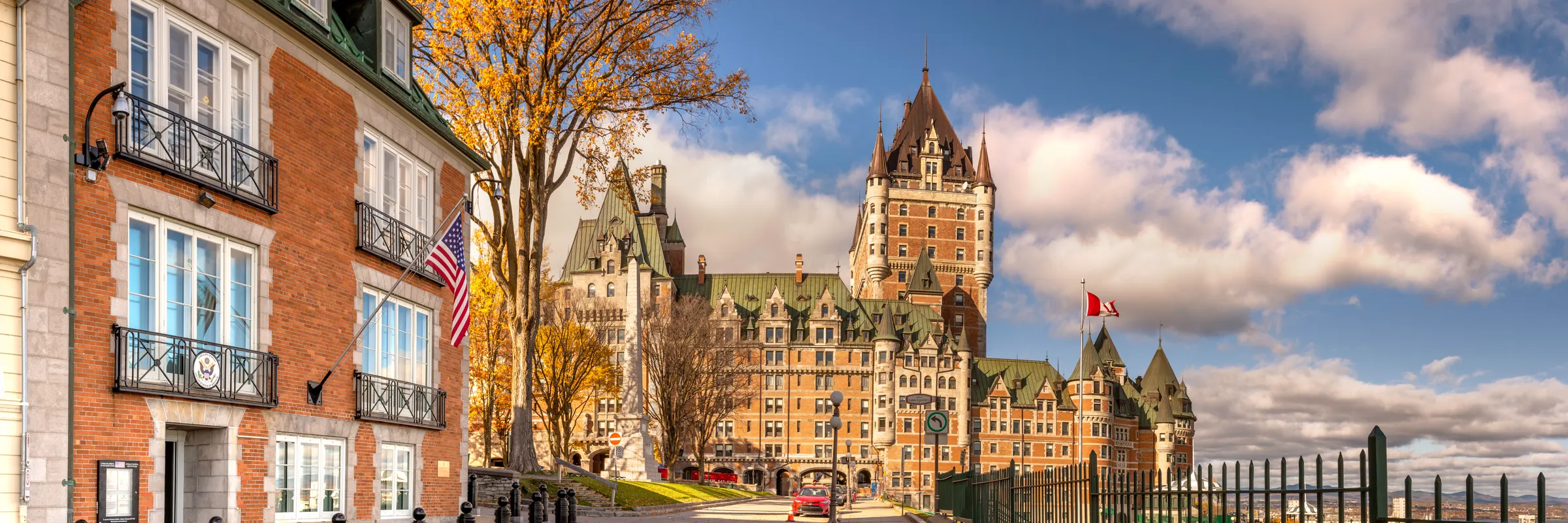
Quebec City: The Château Frontenac, from a street in Old Quebec
Photo: Wilfredor · CC0
Quebec, Canada

Quebec City: how many days you need and the best months to go

Quebec City was founded in 1608 and is the oldest French-speaking city in the Americas, and it is the only city north of Mexico that still has its fortification walls. It sits on a cliff over a narrowing of the Saint Lawrence — the name means roughly 'where the river narrows' in Algonquin — and the old town inside the walls is a UNESCO World Heritage site you can walk across in twenty minutes. Two days does it. Three if you want the surroundings, and the season changes the trip completely.

Short answers

What people ask before booking

How many days do you need in Quebec City?

Quebec City needs two days for the walled old town and three to add Montmorency Falls and the Île d'Orléans. Choose summer or winter deliberately: they are two different trips, and the shoulder months give you neither.

What is the best month to visit Quebec City?

September and October — Autumn: the colour, and the crowd gone. June — Warm, long days, before the peak.

Which months are worth avoiding in Quebec City?

March and April — The thaw: grey, wet and between two seasons. May and November — The two empty edges.

How many days Quebec City needs

Two days is honest and enough. The old town is small — a walled upper town on the cliff and a lower town at the water, joined by stairs and a funicular — and one day covers it properly: the ramparts, the Château Frontenac, Place Royale and the Petit-Champlain quarter. The second day is for the Plains of Abraham, the Musée national des beaux-arts and the neighbourhoods outside the walls, which is where the city actually lives.

A third day buys what is around it: Montmorency Falls, higher than Niagara though far narrower, fifteen minutes out; the Île d'Orléans, an agricultural island in the river with cider houses and strawberry farms; and Sainte-Anne-de-Beaupré. Montreal is three hours by train, which makes the two an easy pair rather than a choice.

The walls, and the four hundred years

Samuel de Champlain founded a trading post here in 1608, and the cliff position is the whole reason: it commands the narrowest point of the Saint Lawrence, and whoever held it controlled access to the interior of the continent. The British took it in 1759 on the Plains of Abraham in a battle that lasted less than an hour and decided the future of North America, and the walls you walk today were largely built or rebuilt by the British afterwards.

No other city north of Mexico kept its fortifications. American cities demolished theirs in the nineteenth century as the frontier moved west; Quebec kept its because a British governor intervened in the 1870s to stop them being torn down. That is why the old town looks the way it does, and why the UNESCO listing exists.

  • The ramparts — you can walk the full circuit of the walls, which takes about an hour and is free.
  • Château Frontenac — a railway hotel from 1893, said to be the most photographed hotel in the world. The terrace beside it is the view.
  • Petit-Champlain and Place Royale — the lower town, the oldest commercial street in North America, and the stone square where the city began.
  • Plains of Abraham — the battlefield, now a large park on the cliff. The 1759 battle here decided which empire got Canada.
  • Montmorency Falls — higher than Niagara, fifteen minutes out, with a suspension bridge across the top and stairs down the side.

The winter, and what it actually means

Quebec City has one of the harshest winters of any city its size in the world, and being honest about it matters. Temperatures below minus twenty are normal, the snow lies from December into March and the total each winter is measured in metres, not centimetres. This is not a mild European cold.

It is also the reason many people come. The Carnaval de Québec is one of the largest winter carnivals in the world, running for about two and a half weeks from late January into February; there is an ice hotel rebuilt every year outside the city; and the old town under snow is genuinely one of the great winter sights of North America. The city is built for it — heated walkways, cleared streets, restaurants that fill up rather than close.

What it demands is real equipment. Proper boots with grip, a coat rated for the temperature, and layers; a coat that works in Paris in January does not work here. Plan indoor gaps into every day. And check whether Carnaval falls in your dates, because it moves and it fills the city.

The language, honestly

Quebec is French-speaking and the province takes that seriously as a matter of law and identity, not preference. In the old town and anywhere touristic, English is widely spoken and you will have no practical difficulty. Outside it, in ordinary shops and neighbourhoods, French is the working language and English is not guaranteed.

The useful thing is not fluency but effort. Opening with bonjour rather than hello changes the temperature of an interaction more than anything else you can do here, and it is genuinely appreciated even if the conversation continues in English. The reverse — assuming English — is the thing visitors get wrong. Quebec French sounds different from the French of France, which surprises people who studied the latter; that is a matter of accent and vocabulary, not of being understood.

The two levels, and the stairs

The city is built on and under a cliff, and the split between the upper town on top and the lower town at the water is the thing to plan around. They are connected by a funicular, which is small and cheap, and by several sets of stairs, of which the Escalier casse-cou — the breakneck staircase — is the oldest and steepest.

This matters for two reasons. In winter the stairs ice up and the funicular becomes the sensible route. And the cliff means the city is far more vertical than its small footprint suggests: a map showing two hundred metres between points does not show the fifty metres of height between them. Good shoes matter here in every month.

What to eat in Quebec City, and where

Québécois cooking is French technique applied to a cold country with long winters: root vegetables, pork, game and preserved things, plus the maple that the province produces most of the world's supply of.

  • Poutine

    What to order

    The dish that is genuinely from here

    Chips with fresh cheese curds and hot gravy poured over, so the curds soften but still squeak. It was invented in rural Quebec in the 1950s and it is a matter of provincial identity, not a novelty — there are arguments about which town did it first. The curds must be fresh and at room temperature, which is why it does not travel.

    Check it on Wikidata
  • Tourtière

    What to order

    The Christmas Eve dish, available all year

    A double-crust meat pie of minced pork, beef or game with warm spices, eaten traditionally after midnight mass on Christmas Eve. Every family has a recipe and they disagree about all of it, and the Lac-Saint-Jean version is a different, much larger dish entirely. Served with ketchup or pickled beets, which is not a joke.

    Check it on Wikidata
  • Tire d'érable

    What to order

    The spring thing, poured on snow

    Maple sap boiled down and poured hot onto clean snow, where it sets in seconds into a chewy ribbon you roll onto a stick. It happens at sugar shacks during the sap run, roughly March into April, and the season moves with the thaw each year. It is the single most Québécois thing you can eat.

    Check it on Wikidata
  • Pâté chinois

    What to order

    The everyday dish with a misleading name

    Layered minced beef, corn and mashed potato, baked — the Québécois version of a shepherd's pie. Despite the name it has nothing to do with China, and the origin of that name is genuinely disputed. It is school-canteen food that people are sentimental about, and every diner has it.

    Check it on Wikidata
  • Viejo Quebec

    Where to look

    The old town, and what the walls contain

    The walled historic core, a UNESCO World Heritage site, split between an upper town on the cliff and a lower town at the river. You can walk the whole circuit of the ramparts in about an hour, for free. It is small enough to cross in twenty minutes and steep enough that it does not feel it.

    Check it on Wikidata

When to go, and what each month costs you

This is a city of two real seasons and two short transitions: a warm, busy summer and a severe, spectacular winter, with a beautiful autumn between them and a mud season in spring. Choose which of the two you want; both work.

  • September and October

    Go now

    Autumn: the colour, and the crowd gone

    The best window of the year. The summer visitors leave, the maples turn through late September and October, and the weather stays comfortable for walking. The Île d'Orléans and the surrounding hills are the reason people plan trips around this. Prices ease from the summer peak. Book ahead for the colour weeks.

  • June

    Go now

    Warm, long days, before the peak

    Everything is open, the terraces are out, the days are long and the July crowd has not arrived. The best value of the warm months. Saint-Jean-Baptiste day on 24 June is Quebec's national holiday and a genuine city-wide celebration — worth catching, and it books up.

  • July and August

    Worth it, but

    Peak summer: everything open, everything full

    Warm, humid, and the busiest stretch of the year, with festivals through both months and the old town crowded through the middle of the day. Hotel prices are at their highest. Go early in the morning and late in the evening and it is lovely; between eleven and four it is a queue.

  • January and February

    Worth it, but

    Deep winter: Carnaval, snow, and serious cold

    Carnaval runs about two and a half weeks from late January into February and the dates move, so check the year. The old town under snow is extraordinary and the city is built to function in it. It is also below minus twenty regularly, and it demands proper boots and a real coat. Come deliberately, not by accident.

  • December

    Worth it, but

    Christmas markets, in early winter

    The German-style Christmas market and the old town lit and snowed on, which is exactly the postcard. Cold is setting in and the days are very short. Prices rise over the holidays. Good if the season is the reason; the snow is not yet as reliable as in January.

  • March and April

    Think twice

    The thaw: grey, wet and between two seasons

    The snow goes dirty and then goes, leaving grey streets and mud, and it is too late for winter and too early for spring. The one redeeming thing is the sugar shacks, which run through the sap season here. Cheapest weeks of the year, and the city at its least attractive.

  • May and November

    Think twice

    The two empty edges

    May is cold and often wet with the terraces not yet open; November is grey with the leaves gone and the snow not arrived. Both are cheap and quiet, and both give you a city missing the thing that makes it worth the trip — either the summer outdoors or the winter snow.

Things that change the trip

  • Decide between summer and winter deliberately. They are two completely different trips and the shoulder months give you neither.
  • Open with bonjour rather than hello. It changes the temperature of every interaction and it is the thing visitors most often get wrong.
  • Pack for real cold if you come in winter. Below minus twenty is normal, and a coat that works in Paris in January does not work here.
  • Walk the full circuit of the ramparts. It takes an hour, it is free, and it is the only city wall north of Mexico.
  • Use the funicular between the two levels, especially in winter, when the stairs ice up. The cliff is fifty metres and the map does not show it.
  • Check whether Carnaval falls in your dates. It moves, it runs about two and a half weeks, and it fills the city.

Plan Quebec City and Quebec

A trip that pairs Quebec City with Montreal, the Charlevoix coast or the Saguenay fjord — with the train times, the Carnaval dates and the winter driving conditions worked out around it — is exactly what Premium is for. The free version covers one destination for up to three days.

Destinations