Skip to content
JoruJoru
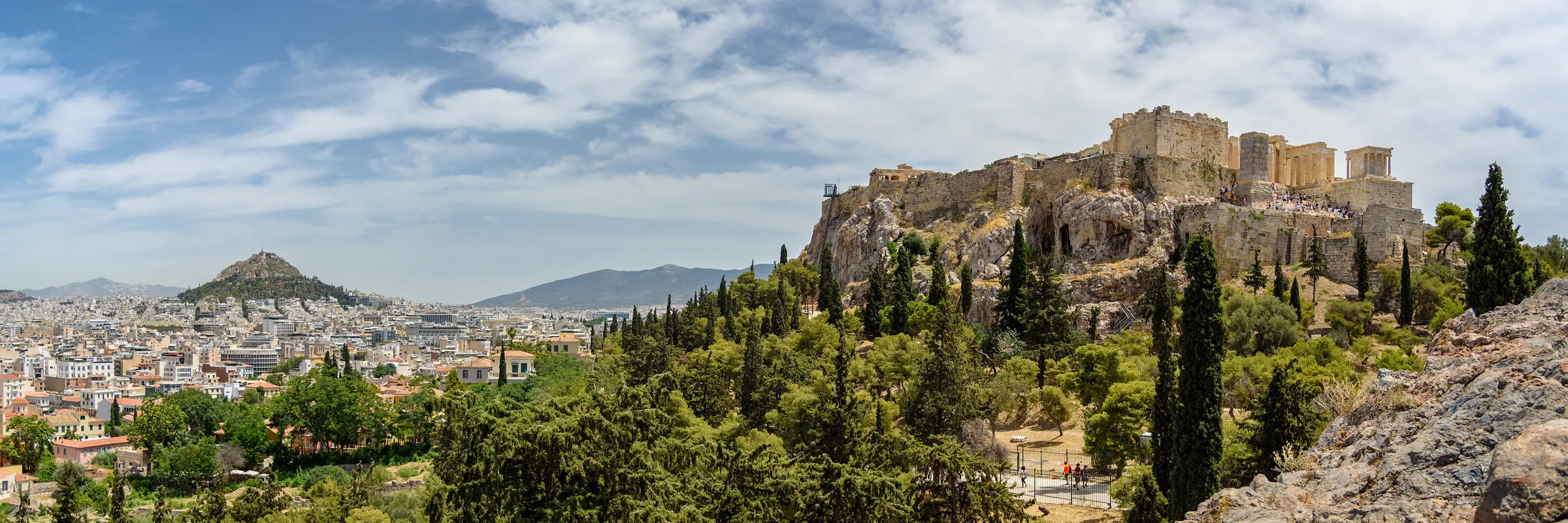
Athens: the Acropolis above the city
Photo: Mustang Joe · CC0
Attica, Greece

Athens: how many days you need and the best months to go

Athens is a city of nearly four million people built in a basin ringed by mountains, and almost all of it went up in the second half of the twentieth century. In the middle stands the Acropolis, continuously occupied for some five thousand years, visible from most of the city and lit at night. Three days is the working figure: one for the classical sites, one for the museums and the neighbourhoods, and one that either stays in the city or takes a boat. The heat decides more here than the calendar does.

Short answers

What people ask before booking

How many days do you need in Athens?

Athens needs three days: the Acropolis and its museum, the Agora and the archaeological collections, and one for the neighbourhoods. A fourth should take a boat from Piraeus.

What is the best month to visit Athens?

April and May — Warm, green, and everything open with no queue. September and October — The heat breaks, the sea is still warm.

Which months are worth avoiding in Athens?

July and August — Heatwaves, and the sites shut in the afternoon. December, January and February — Cold, wet and short on daylight.

How many days Athens needs

Three days is right. One for the Acropolis, the slopes below it and the Acropolis Museum, which belong together and are best done in that order. One for the Agora, Kerameikos, the National Archaeological Museum and a neighbourhood. And one for whatever the trip is actually about — the food, the modern city, or a boat.

A fourth day should leave. The port at Piraeus is forty minutes by metro and the nearest islands are an hour or two beyond it; Delphi, Cape Sounion and Nafplio are all day trips by road. Athens rewards three days and then starts repeating itself.

The Acropolis, and the two things to know before you go

The rock has been in continuous use for around five thousand years, and what stands on it now is mostly from a single burst of building in the fifth century BC. The Parthenon has been a temple, a church, a mosque and an ammunition store, and it was largely wrecked in 1687 when a Venetian shell hit the gunpowder the Ottomans had put inside it.

Two practical things. In the hottest part of summer the site closes for several hours in the middle of the day — a heat measure that has become a regular feature of Athenian summers — so the visit is a morning or an evening, not an afternoon. And the marble on top is polished and lethal in smooth-soled shoes; the walk up is short but slippery. Go at opening, and take water: there is almost no shade on the rock.

One ticket or several, and what the museum is for

The classical sites in the centre are sold either individually or under a single combined ticket that covers the Acropolis, the Ancient and Roman Agoras, Kerameikos, Hadrian's Library and the Temple of Olympian Zeus. If you intend to see more than two of those, the combined ticket is the obvious choice, and it also lets you enter the Acropolis without queueing at the main gate.

The Acropolis Museum is separate and is the one thing here people underrate. It stands at the foot of the rock, its top floor is a glass hall laid out to the exact dimensions and orientation of the Parthenon, and the surviving frieze is mounted there in sequence with plaster casts in the gaps. Those gaps are the ones in the British Museum, and the building makes that argument without saying a word. Do the rock first and the museum second; the order matters.

  • Acropolis and the slopes — the Parthenon, the Erechtheion and the theatres cut into the south side. Go at opening or in the last two hours.
  • Acropolis Museum — the frieze, in order, at the right scale. Best after the rock, not before.
  • Ancient Agora — the marketplace where the classical city actually happened, with the best-preserved Greek temple anywhere in the Hesphaisteion.
  • National Archaeological Museum — twenty minutes north of the centre and the greatest collection of Greek antiquity in the world. Half a day.
  • Kerameikos — the ancient cemetery, quiet and almost empty, and the easiest of the sites to have to yourself.

The city the ruins sit in

Athens grew from a town of a few tens of thousands when it became the capital in 1834 to a metropolis of millions, most of it built fast and in concrete after the war and after the 1922 population exchange with Turkey brought over a million refugees into Greece. The result is a city with no historic skyline to speak of and a great deal of life at street level.

That life is in the neighbourhoods, and they are close together. Plaka is the old quarter under the rock and is pretty and touristic. Anafiotika, above it, is a handful of whitewashed Cycladic houses built by island stonemasons who came to build the king's palace. Psyri and Exarcheia are where the city eats and argues, and Koukaki, on the south side, is where most people now choose to stay.

The islands, and whether to bother

Piraeus is the largest passenger port in Europe and is forty minutes from the centre on the metro. The Saronic islands — Aegina, Poros, Hydra — are one to two hours from it and are genuinely a day trip, which is unusual: from most capitals the islands are a separate holiday.

Hydra is the one worth the day. It has no cars at all — none, by law — so the port town is donkeys, boats and stone, and it is a forty-minute walk to a swimming spot. The Cyclades proper, Santorini and Mykonos, are four to eight hours by ferry and are a different trip; do not try to squeeze them into three days in Athens.

Heat, strikes and the two things that catch people out

Athens is one of the hottest capitals in Europe and the basin traps it. Summer heatwaves regularly push into the low forties, and the city has a heat plan that opens air-conditioned public rooms and closes the archaeological sites in the worst hours. That is not an inconvenience to plan around; in July it is the plan.

The other thing is industrial action. Greece has a strong tradition of general strikes, which are announced days ahead and typically halt ferries, some metro lines and museum openings for twenty-four hours. They are announced, not sudden — check the news the day before if your plan depends on a boat, and keep a flexible morning.

What to eat in Athens, and where

Greek food in Athens is best eaten the way the city eats it: several small plates, shared, over a long time, with the meal built around the table rather than the dish. The single most useful habit here is to order in rounds rather than all at once.

  • Souvlaki

    What to order

    The thing to eat standing up

    Grilled meat on a skewer, or wrapped in flatbread with tomato, onion, yoghurt and chips inside. The chips go in the wrap; that is not a mistake and asking for them out marks you immediately. It is the cheapest good meal in the city and the streets around Monastiraki are full of it.

    Check it on Wikidata
  • Meze

    What to order

    How a Greek meal is actually ordered

    Small shared plates — dips, fried cheese, grilled octopus, wild greens — brought as they are ready rather than in courses. Order four or five for two people, then order again if you are still hungry, which is how the table is meant to work. A taverna will not rush you and the bill comes only when asked.

    Check it on Wikidata
  • Bougatsa

    What to order

    Breakfast, and the sweet-or-savoury question

    Filo pastry filled either with semolina custard and dusted with sugar and cinnamon, or with cheese and no sugar at all. They are the same pastry and two different breakfasts, and you have to say which you want. Eaten hot, from a bakery, at eight in the morning.

    Check it on Wikidata
  • Loukoumades

    What to order

    The dessert to order at midnight

    Small balls of yeasted dough fried until they puff, then soaked in honey syrup and covered in cinnamon and walnuts. They are served hot and they are the classic late dessert here. The same sweet exists across the former Ottoman world under other names; this is the Greek one.

    Check it on Wikidata
  • Varvakeios

    Market

    The market, and what actually happens in it

    The central market of Athens, in a stone hall of 1886 that has never stopped working — meat and fish under the roof, fruit and vegetables in the street outside, and spice shops in the lanes around. It is loud, it smells strongly and it is not a food court. The cookhouses inside serve tripe soup at dawn to people finishing a shift.

    Check it on Wikidata
  • Psyri

    Where to look

    The neighbourhood for the evening

    A dense quarter of old workshops and low buildings just north of Monastiraki, now the centre of the city's eating and drinking. It changes character completely after dark and it is where to spend an evening rather than in Plaka, which is prettier and more expensive.

    Check it on Wikidata

When to go, and what each month costs you

Athens has a hot-summer Mediterranean climate and the summer is the deciding factor. Spring and autumn are excellent; July and August are genuinely difficult, and that is not a matter of comfort but of what you are able to do in the day.

  • April and May

    Go now

    Warm, green, and everything open with no queue

    The best window of the year: comfortable walking weather, hills still green from the winter rain and the sites usable all day. Greek Orthodox Easter moves between early April and early May and is the busiest domestic week of the year — check where it falls, because much of the city closes and the ferries fill.

  • September and October

    Go now

    The heat breaks, the sea is still warm

    September keeps summer temperatures without the extremity, the sea is at its warmest of the year and the crowds thin after the first week. October is cooler, cheaper and reliably clear. The most comfortable time to be on the Acropolis.

  • March

    Worth it, but

    Cool, cheap and unpredictable

    Chilly mornings, some rain and much lower prices, with the sites almost empty. Good for museums and long walks, poor for the sea and for islands, where the season has not started. Independence Day at the end of the month is a large public holiday.

  • June

    Worth it, but

    Long days, and the heat arriving

    Warm rather than brutal for most of the month, with light until nine and the islands opening up. The last comfortable weeks before the summer proper. Prices climb through the month and the first heatwave usually lands in it.

  • November

    Worth it, but

    The rain returns, and so does the city

    The wettest month, cool and often grey, with the tourist city gone and the real one visible. Museums, food and neighbourhoods all work perfectly. The Acropolis in the rain is a poor use of a ticket.

  • July and August

    Think twice

    Heatwaves, and the sites shut in the afternoon

    The basin traps heat, temperatures push into the low forties in a heatwave and the archaeological sites close for hours in the middle of the day when they do. August is also when Athenians leave for the islands, so parts of the city shut. If you must come, plan mornings and evenings only.

  • December, January and February

    Think twice

    Cold, wet and short on daylight

    Grey and damp with occasional real cold, and the outdoor half of the city — which is most of it — unpleasant to use. Prices are the lowest of the year and the museums are empty. The islands are effectively closed.

Things that change the trip

  • Do the Acropolis at opening or in the last two hours. In summer the site closes in the middle of the day, and there is no shade on the rock.
  • See the rock first and the museum second. The Acropolis Museum is built to be understood after you have stood on the site, not before.
  • Take the combined ticket if you want more than two sites. It covers six of them and it gets you past the main gate queue.
  • Check where Orthodox Easter falls. It moves between early April and early May and is the fullest week of the Greek year.
  • Sleep in Koukaki or Psyri rather than Plaka. Both are minutes from the rock, cost less and are where the city actually eats.
  • Give a day to Hydra if you have one. It is under two hours by boat, it has no cars at all, and it is the easiest island day trip from any European capital.

Plan Athens and the islands beyond it

A trip beyond four days, or one that adds Delphi, Nafplio, the Saronic islands or a run out to the Cyclades with the ferries and the heat arranged around them, is exactly what Premium is for. The free version covers one destination of up to three days.

Destinations