



Skip to content
JoruJoru
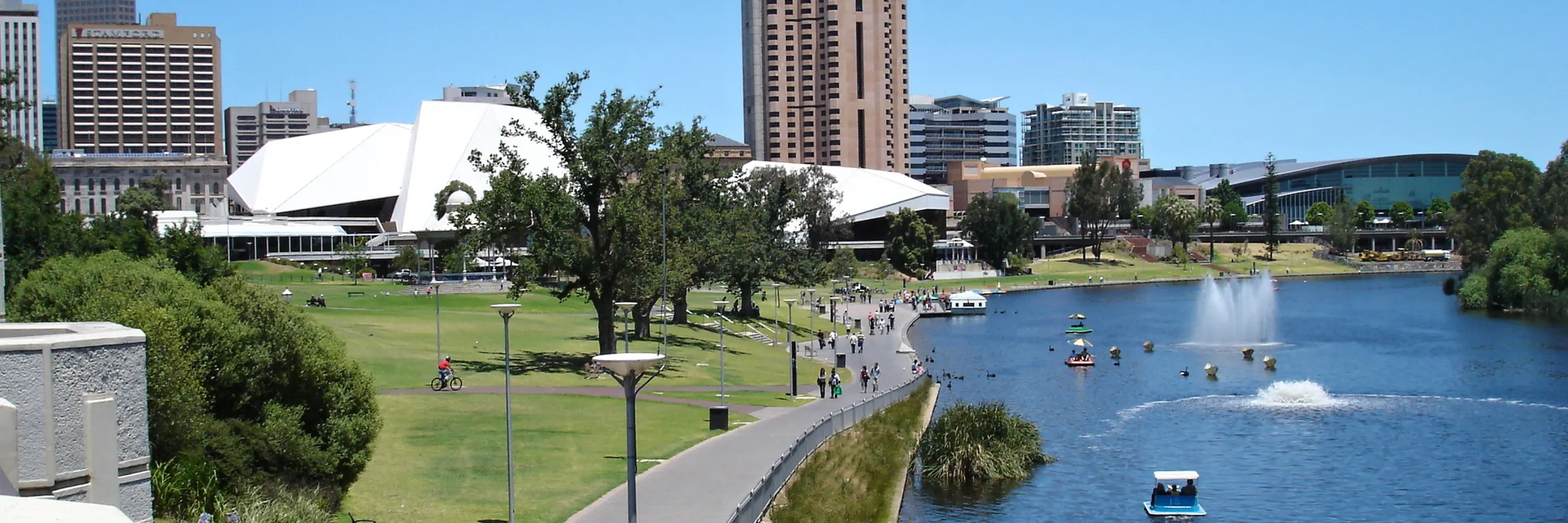
Adelaide: the city across the Torrens
Photo: Pavel Špindler · CC BY 3.0
South Australia, Australia

Adelaide: how many days you need and the best months to go

Adelaide was planned before it was built. Colonel William Light drew a one-mile grid in 1837 and surrounded it completely with a belt of parkland, and that plan survives — the city centre is still a rectangle of streets inside a green ring, which no other Australian capital has. It was also settled by free migrants rather than convicts, which the city has never stopped mentioning. Two days covers it. A third is a wine region, and choosing which is the actual decision.

Short answers

What people ask before booking

How many days do you need in Adelaide?

Adelaide needs two days for the grid, the market and the museums, and a third for one wine region — four are within ninety minutes and doing two in a day wastes both.

What is the best month to visit Adelaide?

March and April — The best weather of the year, and the festivals. October and November — Spring, green hills and everything open.

Which months are worth avoiding in Adelaide?

January and February — The most extreme heat of any Australian capital. June, July and August — Winter: wet, grey and short days.

How many days Adelaide needs

Two days covers the city comfortably: the grid, the market, the museums along the cultural boulevard and an evening in one of the laneways. Adelaide is small and flat and the centre genuinely walks in twenty minutes end to end.

The third day is wine, and it is the reason to come. Four distinct regions sit within an hour and a half of the centre, which is closer than any other Australian capital manages, and they make completely different wine. Beyond three days you are touring South Australia rather than visiting Adelaide, which is what the state is for.

The grid, the parklands and the free settlers

Colonel William Light laid out the city in 1837 on a one-mile square grid with five public squares, and then did the thing that makes Adelaide unusual: he ringed the entire centre with a continuous belt of parkland, and North Adelaide beyond it with another. The parklands are still there, still public, and still stop the city from touching its suburbs.

The other founding fact is that South Australia was established as a free colony in 1836 and never received transported convicts, unlike New South Wales, Tasmania or Queensland. It attracted religious dissenters — particularly German Lutherans, who settled the Barossa and planted the vines. That is not a footnote: it is why the state's oldest wine district has German town names.

  • The grid — the museums, the library, the university and the art gallery all sit along one boulevard, which is an efficient morning.
  • The Central Market — a covered market since 1869, and the best single hour in the city. Closed Sundays and Mondays, which catches people out.
  • The east end and the west end — the two ends of the main street: one has the restaurants and the other the bars and the small venues.
  • North Adelaide — across the parklands and the river: older, quieter, residential and with the pubs that were there first.
  • Glenelg — the beach suburb, reached by a tram that runs from the city centre to the sand in half an hour. The easiest thing to do with a spare afternoon.

Which wine region to pick

This is the real planning question, and it is a genuinely good problem to have: four regions, all within ninety minutes, all making different wine for different reasons. Do one per day and do not attempt two.

The variable is climate. Two of them are warm valley floors that make big red wine; two are cool and higher and make white and pinot. What you like decides where you go.

  • Barossa Valley — an hour north-east, warm, and the most famous. Old shiraz vines, some among the oldest producing vines anywhere, and German heritage in the town names and the bakeries.
  • McLaren Vale — forty-five minutes south, warm, coastal and smaller-scale, with the sea at the end of the vineyards. The easiest one to combine with a beach.
  • Adelaide Hills — twenty minutes east and several hundred metres up, cool climate, making sauvignon blanc, chardonnay and pinot. The closest and the greenest.
  • Clare Valley — two hours north, cooler than it looks, and the country's benchmark for riesling. The furthest and the quietest.
  • Do not drive yourself for a full day of tastings. Small-group tours run to all four and cost less than the alternative.

The festival city, and what that means in March

Adelaide calls itself the festival state and in one month it is entirely accurate. In late February and through March, an arts festival, a fringe festival, a writers' week and a food and wine event all run at once, and the fringe is one of the largest arts festivals in the world by ticket sales — second only to Edinburgh.

The effect on a trip is total. The city, which is normally quiet in the evening, has hundreds of shows a night and open-air venues in the parklands. Accommodation books out months ahead and prices double. It is either the best time to come or the worst, and there is no middle position.

The heat, and why it matters more here

Adelaide has a Mediterranean climate and gets the most extreme summer heat of any Australian capital. Temperatures above forty degrees are normal in January and February, often for several consecutive days, and the city has a formal name for it — a heatwave — with public cooling centres and warnings.

This is not a detail to plan around; it is the difference between a good trip and an endured one. In those weeks the outdoor half of the day happens before ten in the morning, the wine regions are still fine because tastings are indoors, and the beach at Glenelg does the rest. The rest of the year the climate is one of the most pleasant in the country.

  • Total fire bans are declared on extreme days and mean no open flames anywhere, including in the wine regions. Check before driving out.
  • The tram to the beach is free within the city centre, which is a small thing that surprises visitors.
  • Sunday closing is real outside the centre. The Central Market shuts Sunday and Monday and a lot of the suburbs slow right down.
  • Water is drinkable everywhere and the sun is fierce; the UV here is stronger than the temperature suggests, even on a cool day.

What to eat in Adelaide, and where

South Australia produces a large share of the country's wine and a great deal of its food, and Adelaide is where all of it converges. The market is the whole argument — everything within ninety minutes of the city ends up on those stalls, and it has been running since 1869.

  • Adelaide Central Market

    Market

    The one fixed appointment in the city

    A covered produce market in the middle of the grid, trading since 1869 and still the largest of its kind in the southern hemisphere. Cheese, smallgoods, seafood, fruit and a dozen counters to eat at, and the multicultural half of the city's food history in one building. Closed Sunday and Monday; go early on a Saturday.

    Check it on Wikidata
  • Pie floater

    What to order

    The local dish that sounds like a dare

    A meat pie floating upside down in a bowl of thick pea soup, with tomato sauce on top. It was sold from horse-drawn pie carts on street corners from the 1890s and it is genuinely local to Adelaide, listed as a state heritage icon. It is late-night food, it is not elegant, and it is the one dish this city can claim outright.

    Check it on Wikidata
  • Shiraz

    What to order

    The grape the state is built on

    The red variety that made South Australia's reputation, grown in the warm valleys since the 1840s. Some of the Barossa vines are among the oldest producing vines in the world, having escaped the phylloxera louse that destroyed Europe's vineyards. Dense, dark and warm-climate, and completely different from the cool-climate versions elsewhere.

    Check it on Wikidata
  • Barossa Valley

    Where to look

    The famous valley, and its German half

    An hour north-east, settled by German Lutheran migrants in the 1840s who planted vines and stayed. The town names, the bakeries and the smallgoods are all still German, and the wineries range from enormous historic names to single-family operations. The warm-climate reds are the point.

    Check it on Wikidata
  • Adelaide Hills

    Where to look

    The cool-climate region, twenty minutes away

    The range immediately east of the city, several hundred metres higher and several degrees cooler. Altitude is the whole explanation: it keeps the acid in the fruit, which is why this is where the white wine and the pinot come from. Closest to the city, greenest, and easiest to do in half a day.

    Check it on Wikidata

When to go, and what each month costs you

Southern hemisphere, so summer runs December to February. Adelaide is the driest capital in the driest state of the driest inhabited continent, with a Mediterranean climate: hot dry summers, mild wet winters, and two long excellent shoulders. The summer extreme is the thing to plan around.

  • March and April

    Go now

    The best weather of the year, and the festivals

    Warm days, cool evenings, the vintage in the wine regions and the most settled weather on the calendar. March is also the festival month, when the city runs several major events at once and the accommodation prices roughly double. Book far ahead or come in April.

  • October and November

    Go now

    Spring, green hills and everything open

    Warm without being hot, the parklands and the hills at their greenest and the wine regions in leaf. Fewer visitors than March and considerably cheaper. The best value window of the year.

  • December

    Worth it, but

    Warm, and the Australian holidays begin

    Hot but not yet extreme, with long evenings and the beach in use. The domestic holiday season starts around Christmas and runs into January, which fills the coast and empties the city. Fine, if you book.

  • May and September

    Worth it, but

    The edges of winter, cheap and quiet

    Cool, sometimes wet and very few visitors. The wine regions are open and unhurried, which is an argument in itself, and the hills are green in September. Prices are at their lowest outside midwinter.

  • January and February

    Think twice

    The most extreme heat of any Australian capital

    Temperatures above forty degrees are normal, often for consecutive days, and total fire bans are common. The wine tastings are indoors and the beach helps, but the walking city becomes unusable between ten and five. Prices are high because it is the domestic holiday season anyway.

  • June, July and August

    Think twice

    Winter: wet, grey and short days

    The wettest and coolest stretch, with short days and rain that settles in. It is never properly cold, and the cellar doors, the market and the museums all work perfectly. What you lose is the outdoors and the reason to sit in a vineyard, which is most of what this region is for.

Things that change the trip

  • Pick one wine region and do it properly. Four are within ninety minutes and they make completely different wine; two in a day is a waste of both.
  • Do not drive yourself for a full day of tastings. Small-group tours run to all four regions and cost less than the alternative.
  • Check the Central Market's days. It closes Sunday and Monday, and it is the best hour in the city.
  • Avoid January and February if you can. Forty-degree days are normal and the walking city stops working.
  • Book months ahead for March or accept April. The festival season roughly doubles accommodation prices and fills the city.
  • Take the tram to the beach on a spare afternoon. It runs from the middle of the grid to the sand in half an hour.

Plan Adelaide and the wine around it

A trip beyond three days, or one that adds Kangaroo Island, the Flinders Ranges or a drive along the coast with the distances between them, is exactly what Premium is for. The free version covers one destination of up to three days.

Destinations