How many hours you will have in Rio de Janeiro, and where to stay
Two things decide a short trip: how much free time your arrival and departure times really leave you — something no guide can work out for you — and which area is the best base for you.
With your times and your breaks, how long will you actually have?
Tell us when you arrive and when you leave. We will tell you how many hours you really get to enjoy the city, day by day, once the transfers and your own breaks are set aside.
These are free hours, not a list of sights. We do not know your flight, the queues, opening times or how long it takes to get from one place to another.
Rank what matters most to you, from one to three things, and tick anything you want to avoid. We compare the areas the guide describes and explain why each one fits, catch included.
It sorts what the guide says; it does not score neighbourhoods. It does not look at hotels, today’s prices, safety or accessibility, and it only knows the areas the guide describes.
Every rating comes from what the guide’s table says in words, and the sentence is shown next to it. What the guide does not say is not scored.
The areas the Rio de Janeiro guide describes
Who each one is for and what the catch is, in the guide’s own words.
Copacabana
The most balanced option: plenty of choice, metro, a range of prices.
The catch: The busiest and most uneven: some stretches are considerably better than others.
Ipanema
The best beach, a pleasant atmosphere and good restaurants.
The catch: More expensive than Copacabana for the same thing.
Leblon
The quietest and most affluent area, with the best sense of security.
The catch: The priciest of the lot and slightly removed from the action.
Botafogo and Flamengo
Considerably better prices, with a metro and a very good restaurant scene.
The catch: The beach on this bay is not for swimming; you have to travel.
Santa Teresa
An artists' quarter on the hill, with charm and views.
The catch: Steep, poorly connected at night, and you go downhill for everything.
How much daylight there is in Rio de Janeiro each month
Sunrise and sunset in Rio de Janeiro, on its own clock and with the seasonal time change already applied. It is what decides how much fits into a day, and it swings far more than people expect.
The longest day is in December — 13 h 32 min of daylight — and the shortest in June, with 10 h 44 min. That is a 2 h 48 min swing between them.
4–5 days in April / May / June / July / August / September / October come to roughly 42 h 56 min to 63 h of daylight, depending on the month you pick and how long you stay.
Month
Sunrise
Sunset
Daylight
January
05:20
18:43
13 h 23 min
February
05:41
18:32
12 h 51 min
March
05:54
18:09
12 h 15 min
April
06:05
17:39
11 h 34 min
May
06:18
17:20
11 h 2 min
June
06:31
17:15
10 h 44 min
July
06:33
17:23
10 h 51 min
August
06:18
17:36
11 h 19 min
September
05:50
17:46
11 h 57 min
October
05:20
17:56
12 h 36 min
November
05:01
18:13
13 h 12 min
December
05:01
18:33
13 h 32 min
Worked out for Rio de Janeiro from its position and its time zone (America/Sao_Paulo). The times are approximate — the sun shifts a couple of minutes from one year to the next — and they leave out twilight, which adds some light before and after. Each month is worked out from its 15th, the day that looks most like the month as a whole.
You know how much time you have. Joru tells you what to do with it.
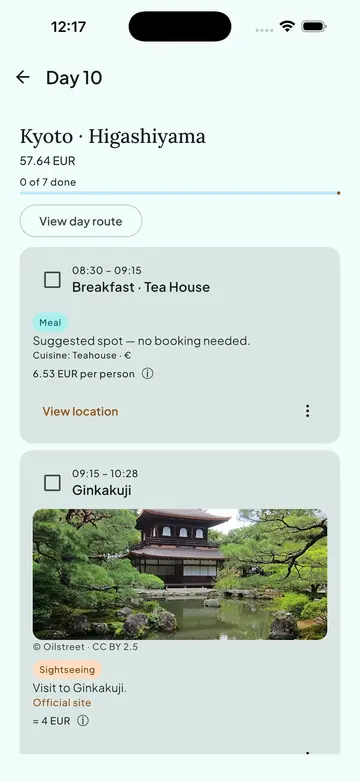
Give it the days you have just worked out and Joru builds the whole trip: what to see each day, in what order, and how long it takes to get between them. With real places and real forecasts, not invented ones.
The plan is written on your phone, not on a server: your dates and your tastes never leave it.
Change your mind as often as you like. No credits to spend, no meter running.
Start without an account. Download it, open it, plan.